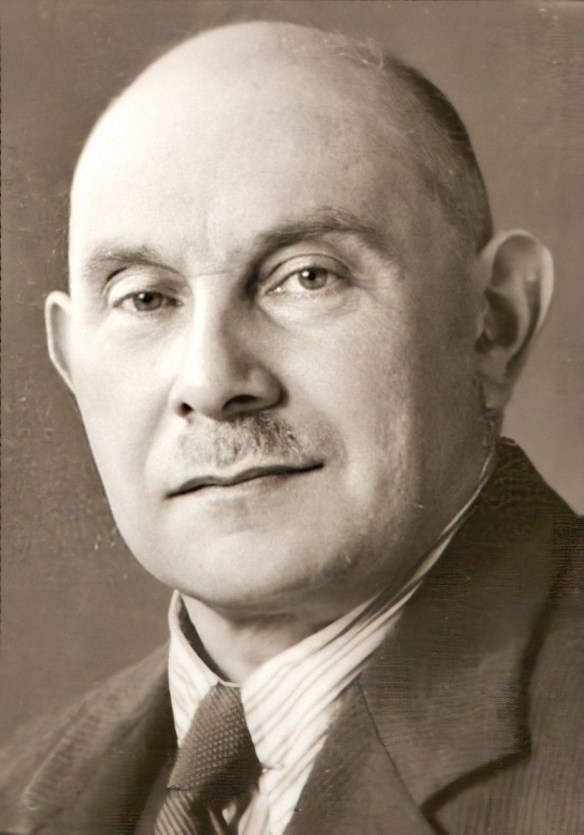
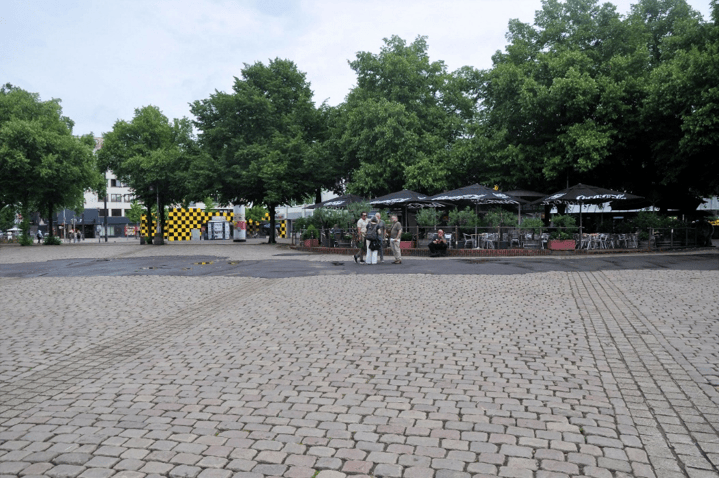
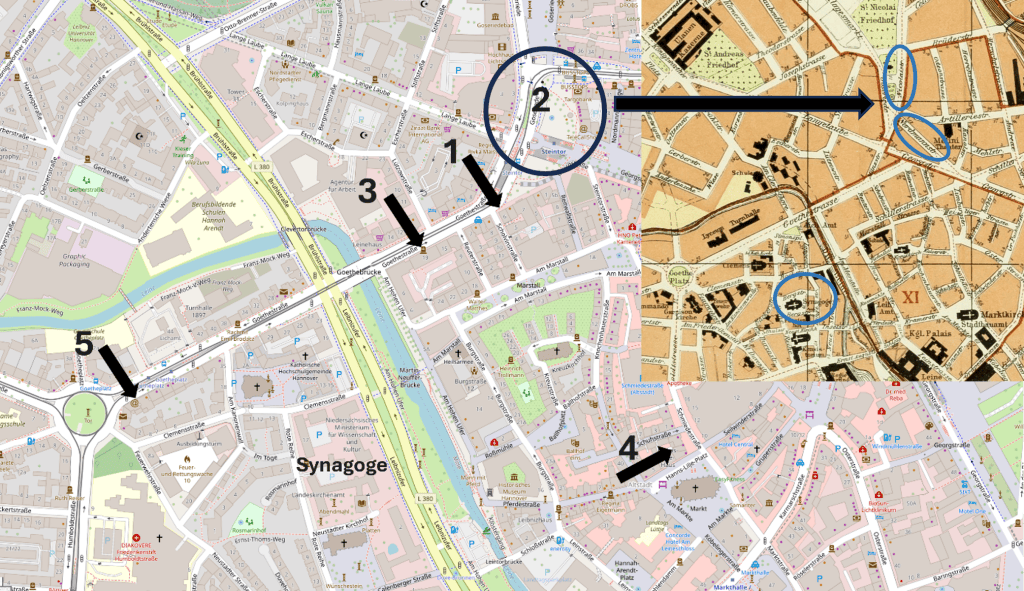
Julius Blumenfeld, geboren am 21. Februar 1885,1 war Isaac und Bienchen Blumenfeld-Rothschilds jüngstes Kind. Mit 16 Jahren zog Julius von Momberg nach Hannover, wo er sich am 3. November 1901, als wohnhaft an der Nordmannstrasse 16 anmeldete.2 An derselben Adresse wohnte auch der Fleischer Louis Wolf.3 Man kann annehmen, dass Julius bei Louis Wolf eine Lehre absolvierte. «Mit Unterbrechung bis 8.7.10» wohnte und eventuell auch arbeitete Julius immer wieder bei seinem Lehrmeister an der Nordmannstrasse 16 bzw. 15.4 Die Nordmannstrasse ist auf der Karte am Ende des Artikels in der Ausschnittskarte blau eingekreist. Diese Strasse existiert nicht mehr. Wo sie früher war, ist heute der Steintorplatz, Nummer 2 auf der Karte.
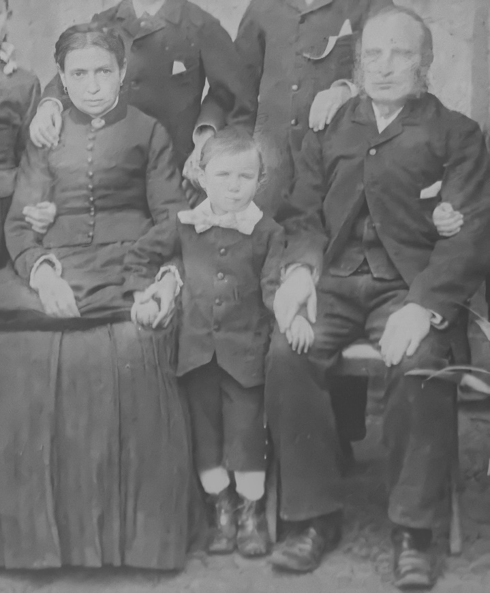
Am 29. Juni 1903 meldete sich Julius in Hannover ab, um auf «Wanderschaft v. Momberg» zu gehen5. In Momberg schrieb er am 1. Juli 1903 an seine Brüder in Amerika, «Da ich gestern von Hannover weg bin, um eine andere Stelle anzunehmen, vielleicht komme ich nach Frankfurt.»6 Ob Julius nach Frankfurt ging oder dort arbeitete, ist nicht bekannt. Am 28. November 1909 meldete er sich bei der Einwohnerkontrolle als wohnhaft an der Nordmannstrasse 15, um sich am 7. Januar 1910 wieder abzumelden, um nach Momberg zu gehen. Er meldete sich knapp fünf Wochen später, am 11. Februar 1910, wieder in Hannover als wohnhaft an der Scholvinstrasse 6. An dieser Adresse hatte der Fleischermeister Gerson Stoppelmann sein Geschäft und seine Wohnung.7 Der Eingang lag an der Goethestrasse. Das Haus ist auf der Karte am Ende des Artikels mit der Nummer 1 gekennzeichnet.
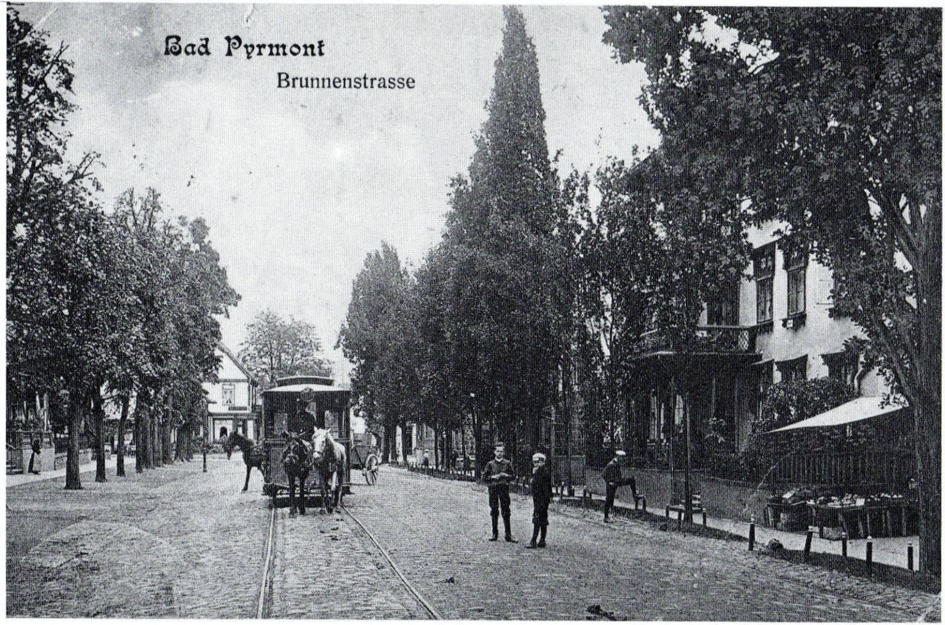
Julius scheint im Juli und August 1910 eine Kur gemacht zu haben. Seine Meldekarte vermerkt einen Aufenthalt in Pyrmont vom 8. Juli bis zum 8. August 1910. Eine KI-Recherche listet die verschiedenen Kuren auf, die Gäste in Pyrmont 1910 erhalten konnten: Trinkkuren, Mineral-, Thermal-, Moor- und Spezialbäder, CO2-Trockenbäder, Inhalationskuren, Elektro- und Lichttherapie, Massage- und physikalische Anwendungen sowie Terrain- und Klimakuren im Kurpark. Das untenstehende Bild wurde ca. 1910 aufgenommen.8
Nach seiner Rückkehr nach Hannover am 8. August 1910 war Julius vier Monate lang unter der Anschrift Scholvinstrasse 6 angemeldet, bevor er am 4. Dezember an die Scholvinstrasse 4 zog. Hier hatte der Fleischer Julius Spiegel sein Geschäft. Kurz bevor er Dina Heiser heiratete, zog Julius am 30. Juli 1912 erneut in die Scholvinstrasse 6.9
Erst im Adressbuch für das Jahr 1913, das dem Datenstand vom 2. Oktober 1912 entspricht, findet sich ein Eintrag für Julius Blumenfeld. Es ist anzunehmen, dass Julius 1912 das Geschäft von Gerson Stoppelmann übernahm. Gerson Stoppelmann wird 1913 weiterhin im Adressbuch aufgelistet, in den darauffolgenden Jahren jedoch nicht mehr.
Am 9. September 1912 heiratete Julius Dina Heiser, geboren am 14. März 1888, Tochter der «Eheleute Bäckermeister Isaack Heiser wohnhaft in Hoof und Jettchen geborenen Müller tot zuletzt wohnhaft in Hoof [Hessen]»10

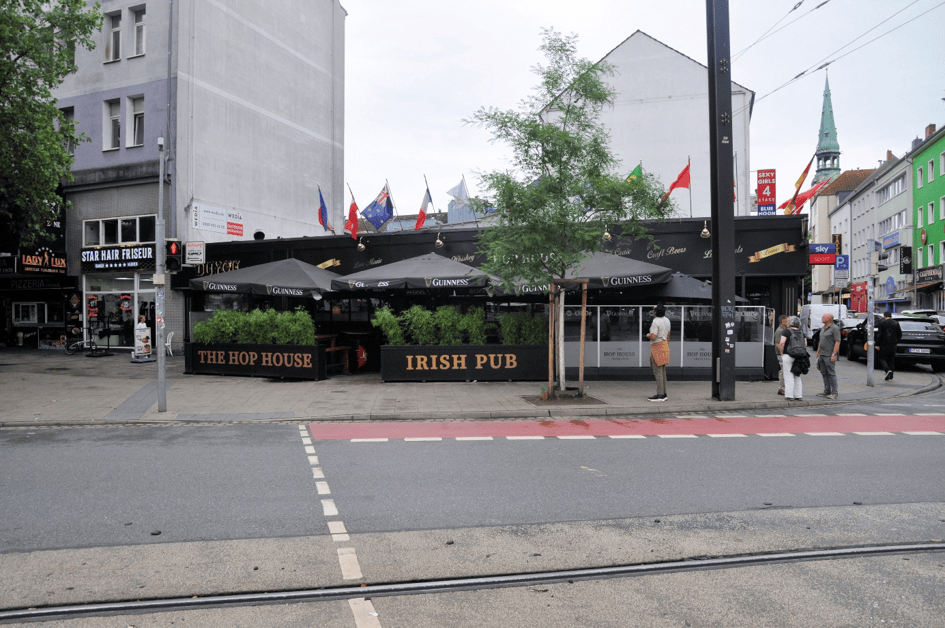
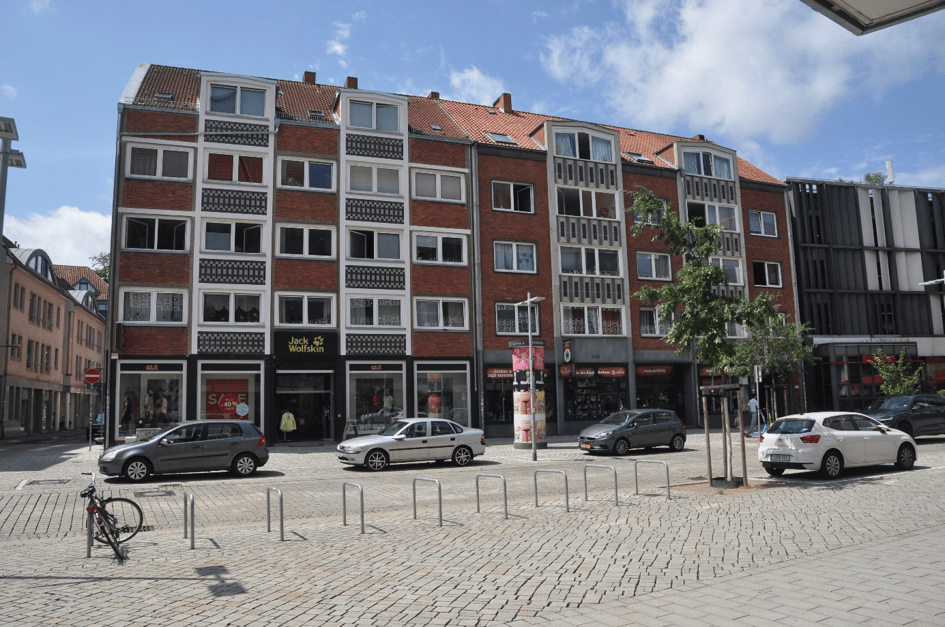
Das frisch vermählte Paar wohnte in der Schlovinstrasse 9 (Nummer 1 auf dem Stadtplan am Ende dieses Artikels). Heute befindet sich an dieser Stelle ein Pub (Vgl. Foto unten). Im Parterre betrieb Julius eine Schlachterei (wahrscheinlich auch eine Metzgerei) und mindestens in den Jahren 1912 bis 1914 dazu eine Wurstfabrik.11 Diese Fabrik wird nur in den Adressbüchern der Jahre 1913 und 1914 erwähnt, und im Branchenverzeichnis findet man unter «Wurst» keinen Eintrag für eine Firma Blumenfeld.
Julius und Dinas erstes Kind, Jakob Heinz, wurde am 25. Februar 1914 geboren.12 Die Tochter Ilse kam am 5. Februar 1917 zur Welt.13
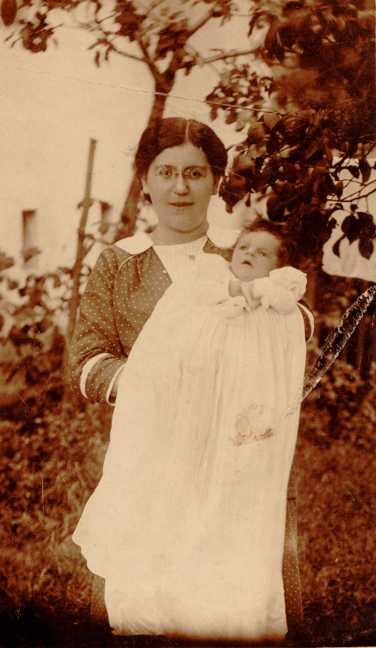
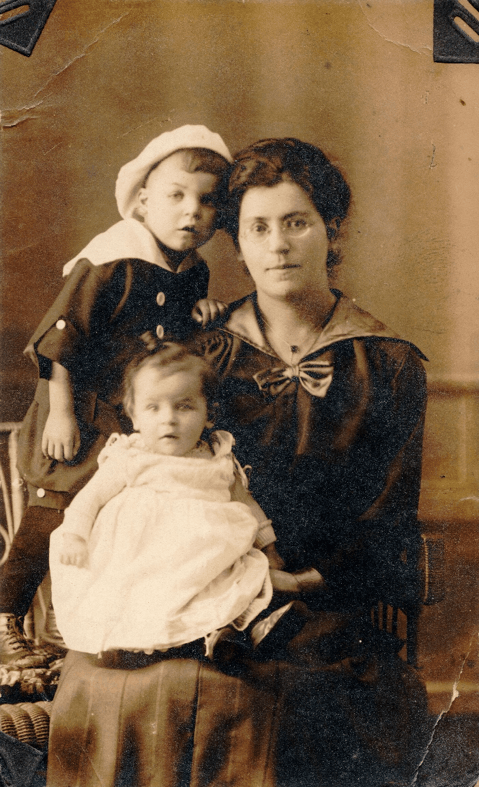
Am 1. Juli 1919 zogen die Familie und das Geschäft an die Nikolaistrasse 2 (Nummer 2 auf dem Stadtplan am Ende dieses Artikels).14 Das vierstöckige Gebäude an der Ecke Nikolaistrasse und Georgstrasse kaufte Julius von seinem Metzgerkollegen Paul Gerdtz.15 Auf der kleinen Karte am Ende des Artikels ist diese Kreuzung unter den zwei blauen Kreisen oben rechts zu sehen.
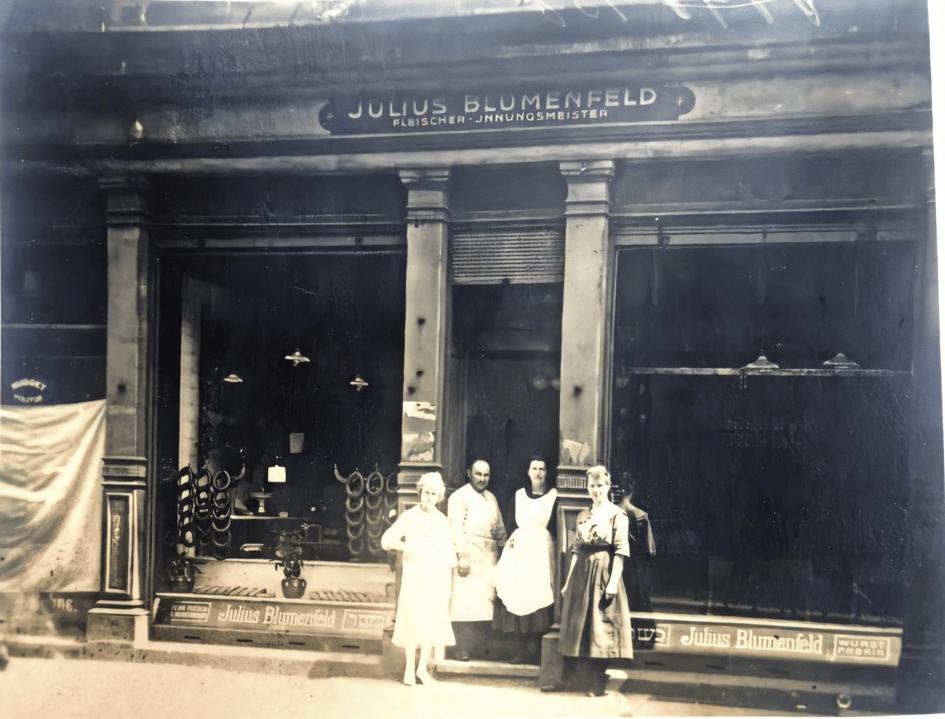
Werner, das dritte Kind des Ehepaars Blumenfeld-Heiser, wurde am 9. Dezember 1921 geboren.16 Das Geschäft lief gut und ermöglichte der Familie Ferien, Musikunterricht sowie eine Privatschule für die Kinder Heinz, Ilse (später Stein) und Werner.17
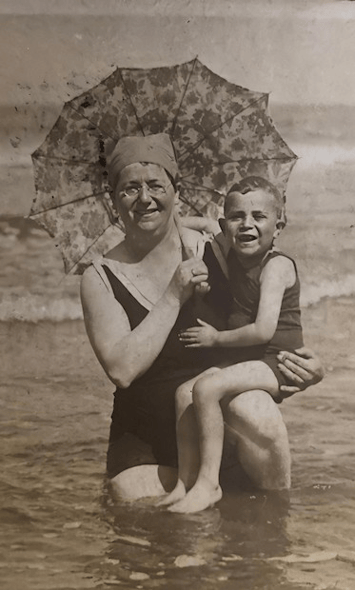
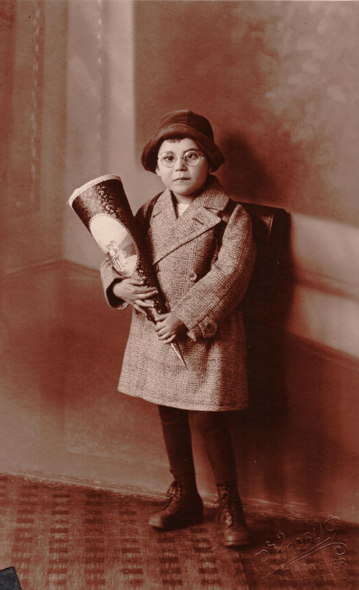
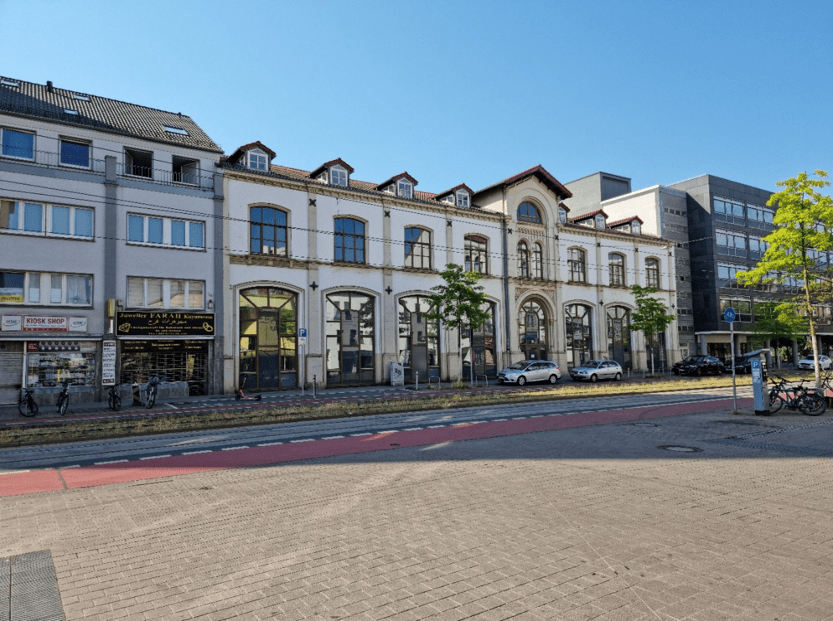
1930 verkaufte Julius das Gebäude an der Nikolaistrasse an den Metzger Fritz Sender. Julius verlegte sein Geschäft an die Goethestrasse 39,18 und die Familie bezog eine Wohnung Am Taubenfelde 23.19 Anderthalb Jahre später konnten Blumenfelds eine Wohnung an der Goethestrasse 40 mieten.20 (Die Nummer 3 auf der Karte am Ende dieses Artikels zeigt die Lage der Goethestrasse 39 und 40.)
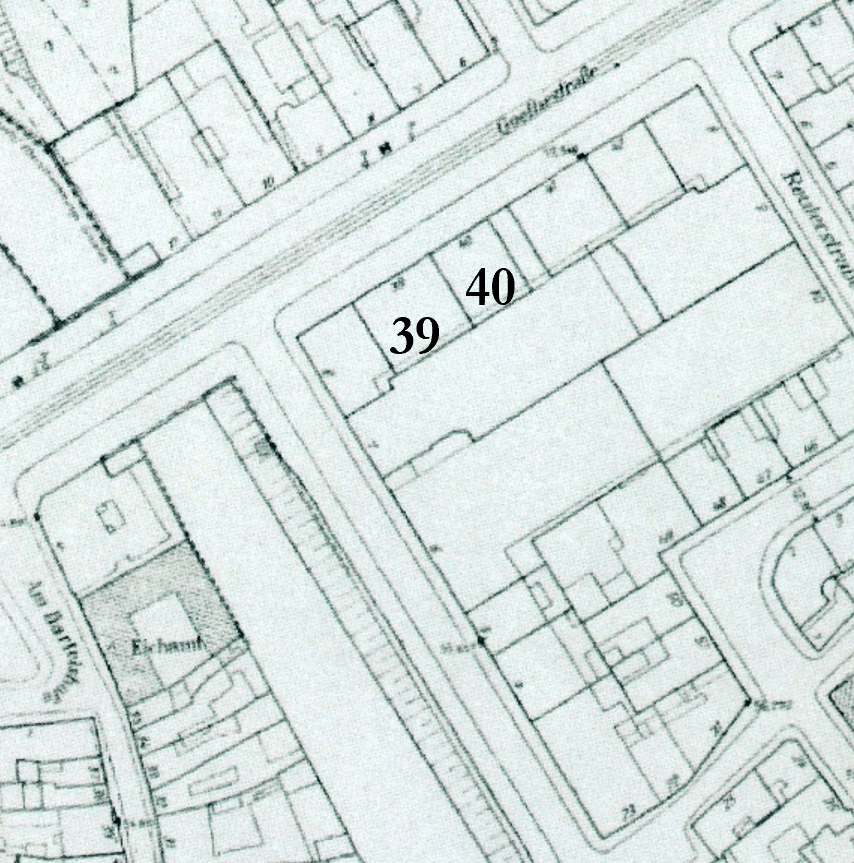
Das Gebäude an der Goethestrasse wurde zwischen 1856 und 1861 als königliche Kutschen-halle errichtet. Im Jahr 1878 wurde es umgebaut, um Lagerräume, Büros und Wohnungen unterzubringen. Nach den Luftangriffen auf Hannover sind von der ehemaligen königlichen Kutschenhalle nur noch sieben der ursprünglich 15 Bögen sowie der Mittelbogen erhalten geblieben.
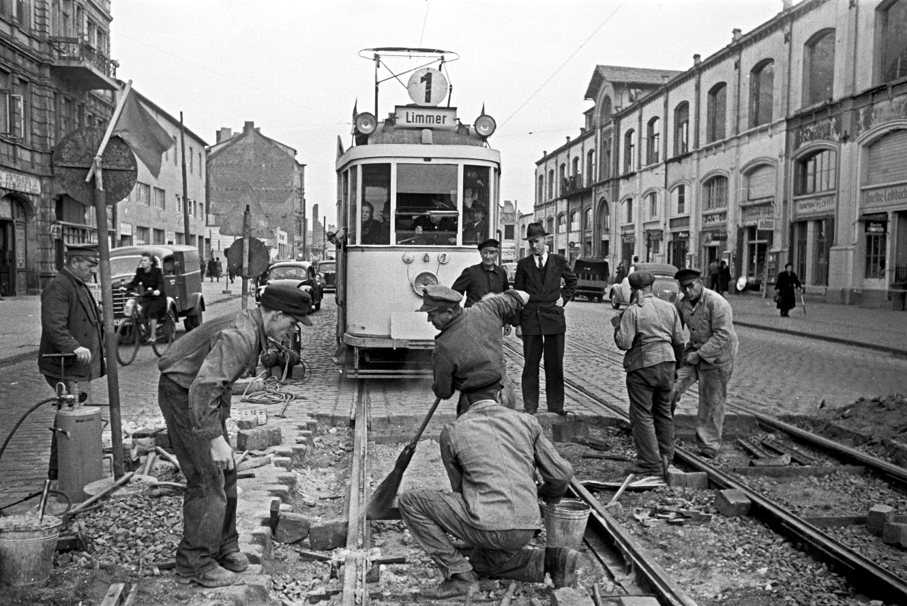
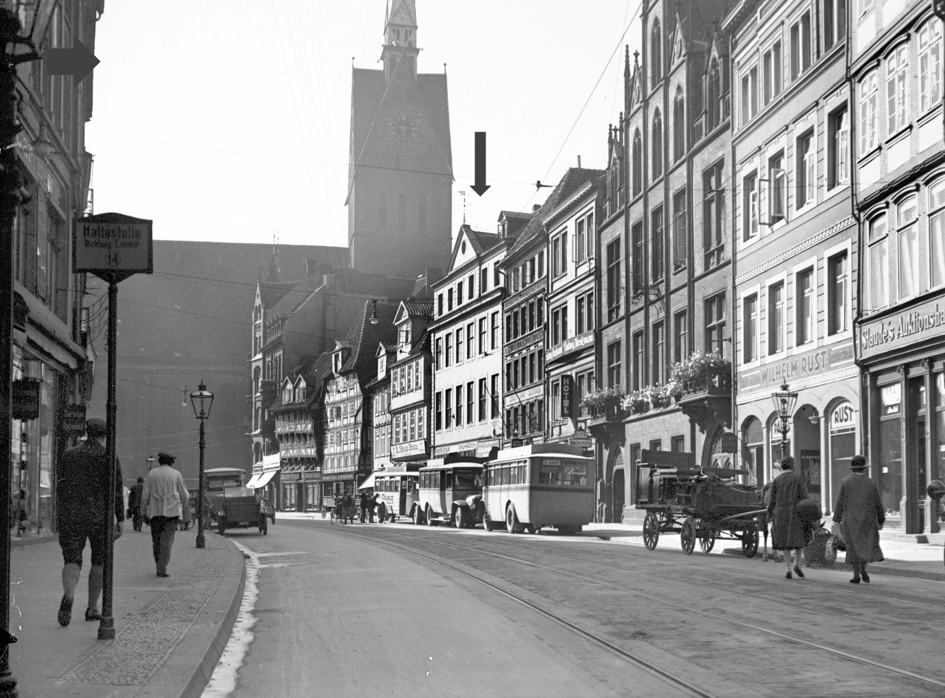
Die Arisierung der jüdischen Geschäfte zwang Julius 1937 seinen Laden an den Fleischer Hermann Kesten zu verkaufen oder zu übergeben.21 Die nationalsozialistische Gesetz-gebung zwang die Familie Bloomfield auch ihre Wohnung aufzugeben, und sie musste zuerst am 1. April 1937 an die Georgstrasse 5122 und dann am 5. September 1938 in ein Haus an der Schmiedestrasse 17 umziehen.23 (Georgestrasse 51 war in der Nähe der Nummer 2 auf der Karte am Ende des Artikels und die Schmiedestrasse 17 bei der Nummer 4.) Im fünfstöckigen Haus an der Schmiedestrasse wohnten laut Adressbuch 28 Partien! Seines Berufes beraubt, führte die Familie einen Mittagstisch, vermutlich in der eigenen Wohnung, um etwas Geld zu verdienen.24
Julius und Dina erkannten die drohende Lebensgefahr und brachten ihre drei Kinder, Heinz, Ilse und Werner, in Sicherheit. Tochter Ilse, die durch die Unterstützung ihres Onkels Joseph in New York nach Amerika ausreisen durfte, versuchte die Ausreise ihrer Eltern aus Deutschland zu organisieren. Ihr Arbeitgeber fuhr sie mit dem Auto nach Winchester, Kentucky, wo sie ihre zwei Onkel, Solomon und Levi treffen wollte. Sie wollte sie bitten, die Kaution für ihre Eltern zu leisten, die ihre Einreise in die USA ermöglichen sollte. Salomon war zu diesem Zeitpunkt im Juni 1938 auf seiner Hochzeitsreise zusammen mit seiner zweiten Frau Elsie Kann Marx.25 Ilse traf sich mit Levi und seiner Tochter Miriam.26 Levi war krank, litt seit ca. 1926 an lokomotorischer Ataxie, einer Krankheit des Bewegungs-apparates,27 und sass im Rollstuhl. Aus ihrem Unternehmen wurde nichts. Ilses Flucht nach Amerika wird hier geschildert.
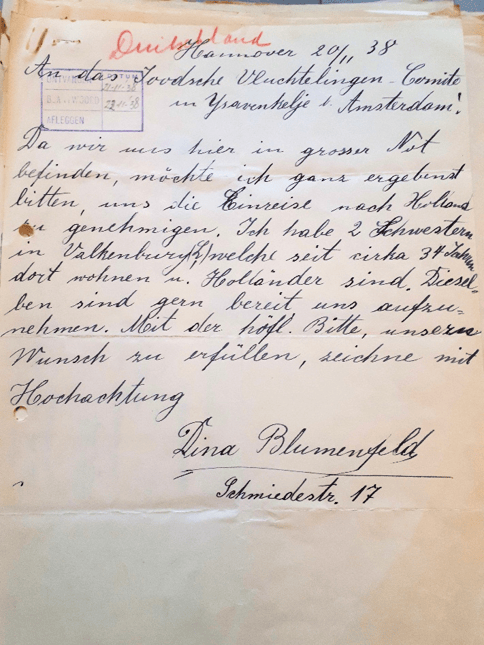
Am 20. November 1938 schrieb Dina Blumenfeld an das Jüdische Flüchtlings-komitee in Amsterdam: «Da wir uns hier in grosser Not befinden, möchte ich ganz ergebenst bitten, uns die Einreise nach Holland zu genehmigen. Ich habe 2 Schwestern in Valkenburg(h), welche seit cirka 34 Jahren dort wohnen und Holländer sind. Dieselben sind gern bereit uns aufzunehmen. Mit der höfl. Bitte, unseren Wunsch zu erfüllen, zeichne mit Hochachtung, Dina Blumenfeld, Schmiedestr. 17.» Ihr Gesuch wurde abgelehnt.28
Dinas Schwestern Mathilde und Bertha waren mit den in Schimmert NL geborenen Brüdern Bernhard29 und Joseph30 Benedik (oder Benedic) verheiratet. Die Flucht in die Niederlande hätte Dina und Julius keine dauerhafte Sicherheit geboten. Mathilde und Bernhard sowie Bertha und Joseph Benedik-Heiser wurden im Vernichtungslager Sobibor, Polen.31
Julius und Dinas Namen erscheinen am 15. Dezember 1941 auf einer Liste der Juden, die von Hannover ins Getto nach Riga deportiert werden sollten.32 Ein Gericht in Hannover erklärte Julius und Dina am 8. Mai 1945 für tot.33
Eine Schulfreundin von Tochter Ilse, Edith (verheiratet) Goldstrom, die mit Julius und Dina im Getto gewesen war, überlebte und konnte Persönlicheres als einen Gerichtsentscheid über Dinas Schicksal liefern. Nach der Internierung hätte Dina an Herzbeschwerden zu leiden begonnen, die unbehandelt geblieben seien und zu ihrem Tod geführt hätten. Sie sagte, sie sei bei Dina gewesen, als sie starb.34
Historiker haben recht detailliert die Geschehnisse im Zusammenhang mit der Deportation der in Hannover verbliebenen 1’600 jüdischen Einwohner35 vom 15. Dezember 1941 beschreiben können:
NSDAP-Gauleiter Hartmann Lauterbacher «ordnete … im August 1941 die zwangsweise Einquartierung der jüdischen Bevölkerung in Massenunterkünften, den sogenannten Judenhäusern, an.»36 Diese Umsiedlung, als Aktion Lauterbacher in der Geschichts-schreibung bezeichnet, wurde dann am 3. und 4. September durchgeführt.
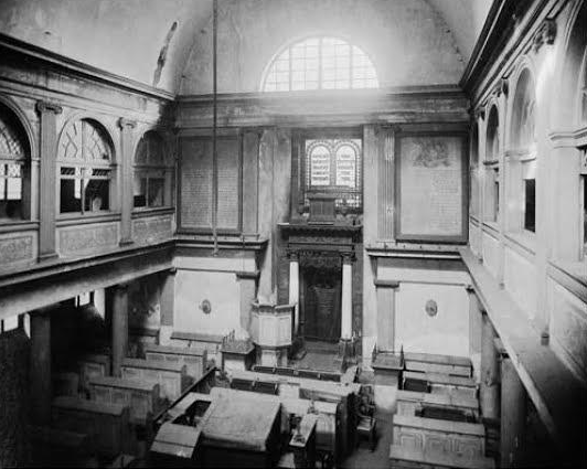
«Innerhalb weniger Stunden wurden mehr als 1’200 Menschen aus ihren Wohnungen vertrieben und in die [16] Judenhäuser [wie die Alte Synagoge, deren Betsaal auf der nächsten Seite rechts abgebildet ist,] eingewiesen; dabei durfte jeder in die ihm zugewiesene Unterkunft nur ‹die notwendigsten Gegenstände und Möbel› mitnehmen, nämlich ‹ein Bett, etwas Wäsche, einige Kleidungsstücke und etwas Geschirr›; Wohnungsschlüssel mussten ‹mit Namen, Strasse und Hausnummer versehen bis zum 4. September 1941, 18 Uhr beim zuständigen Polizeirevier› abgegeben wurden.» Die Wohnungen und deren Einrichtungen wurden geschätzt und für Auktionen freigegeben.37
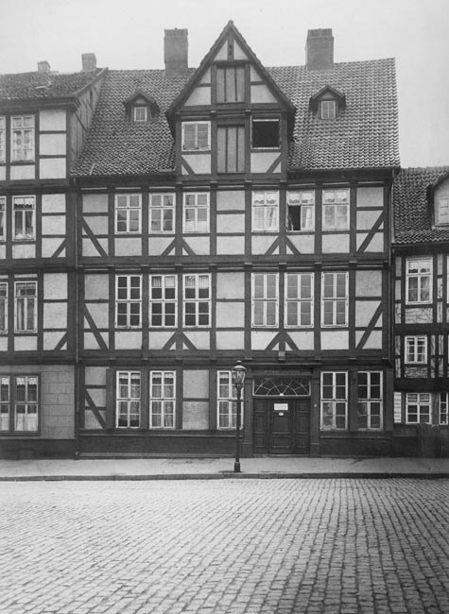
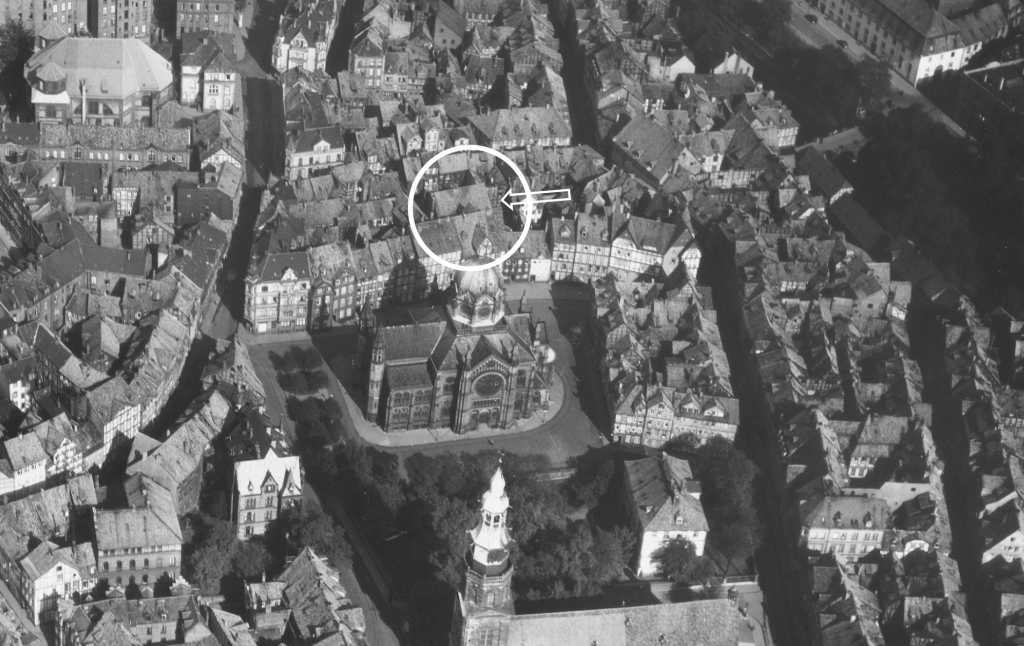
Julius und Dina Blumenfeld-Heiser wurden bis zur Deportation in die Alte Synagoge eingewiesen.38 (Siehe «Synagoge» auf der Karte am Ende des Artikels.) Dort leitete Julius die Gemeinschaftsküche, und Dina war Köchin.39 Der Zugang zur 1827 eingeweihten Alten Synagoge erfolgte durch das Vorderhaus in der Bergstrasse 8.40 Der Standort der Synagoge im Hinterhof dieses Hauses betont die gesellschaftliche Ausgrenzung der Juden vor 1842. «In der Alten Synagoge waren sowohl der Betraum41 [Foto unten42] der Männer im Erdgeschoss wie die den Frauen vorbehaltenen Galerien im Obergeschoss mit Betten oder auch nur Matratzen ausgefüllt. ‹Die Belegung war so eng, dass zwischen den einzelnen Liegestätten nur vereinzelt ein schmaler Gang blieb und die übrigen Untergebrachten über die Betten ihrer Nachbarn zu ihren Betten klettern mussten. […] Es waren Männer, Frauen und Kinder alle durcheinander untergebracht. Die sanitären Verhältnisse spotten jeder Beschreibung.›»43
Die «Niedersächsische Tageszeitung NTZ», das offizielle Organ der NSDAP, berichtete Mitte September 1941 über diese Umsiedlung: «Um schaffenden deutschen Volksgenossen und Bombengeschädigten entsprechende Wohnungen zu geben, sind die Juden in Hannover in einer Anzahl von Wohnungen zusammengelegt worden.»44
«Ende September 1941 wurde der verbliebene Inhalt ihrer Wohnung in der Schmiede-strasse für die Versteigerung zugunsten des Staates amtlich geschätzt – aufgeführt wurden zwei private Küchenmöbel sowie das Mobiliar ihres Schlafzimmers, und ihrer ‹Jüdischen Gaststätte›, letztere mit sechs Tischen, 24 Stühlen und wenigen weiteren Gegenständen ausgestattet. Es fehlten alle anderen im Alltag notwendigen Sachen wie Geschirr, Wäsche usw., die offenbar nach der Zwangsumsiedlung entwendet worden waren.»45
«Zwischen dem 10. und 14. Dezember wurden die zum Transport eingeteilten Personen von den verschiedenen Massenquartieren zur Sammelstelle [auf dem Gelände der Israelitischen Gartenbauschule] nach Ahlem gebracht. Dort wurden strenge Gepäckkontrollen und Leibesvisitationen durchgeführt sowie Wertsachen und Lebensmittel beschlagnahmt.»46
«Am Morgen des 15. Dezember 1941 wurden insgesamt 1’101 jüdische Männer, Frauen und Kinder im Alter von vier Monaten bis zu 81 Jahre […] auf Lastwagen von der Sammelstelle Ahlem zum Bahnhof Fischerhof im hannoverschen Stadtteil Linden gebracht, zwar unter den Augen von Passanten, die jedoch von diesen geflissentlich übersehen.» Die Abtransportierten hatten keine Ahnung vom Ziel der Deportation.
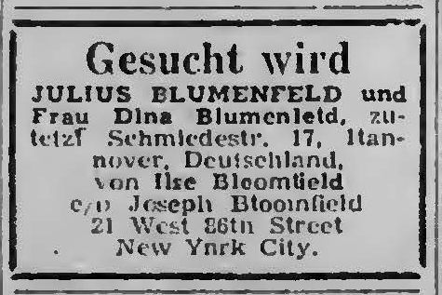
Julius und Dina Blumenfelds Tochter, Ilse Stein-Blumenfeld, erzählte, sie hätte nach dem Krieg vom Roten Kreuz einen Brief erhalten, der ihr mitteilte, Julius sei nach Polen gebracht und dort erschossen worden.47 Vor diesem Bescheid hatte sie mit einem Inserat in der in New York herausgegebenen Immigrantenzeitung «Aufbau» (links) nach ihren Eltern gesucht.48
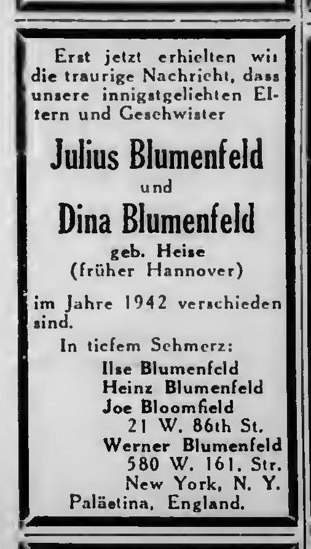
Im September 1945 gab die Familie die untenstehende Todesanzeige auf.49 Nur 68 der nach Riga deportierten Juden aus Hannover überlebten.50
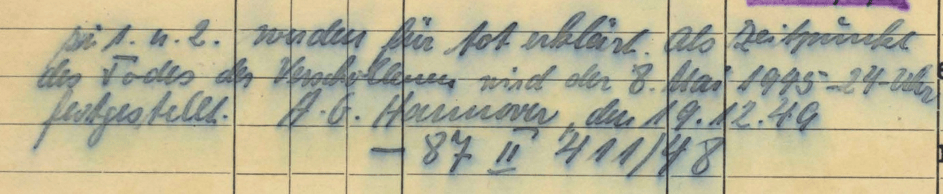
Der letzte Eintrag auf der Meldekarte von Julius und Dina lautet: «Die 1. u. 2. [Julius und Dina Blumenfeld] wurden für tot erklärt. Als Zeitpunkt des Todes der Verschollenen wird der 8. Mai 1945, 24 Uhr festgestellt. A[mts] G[ericht] Hannover, den 19.12.49.»51
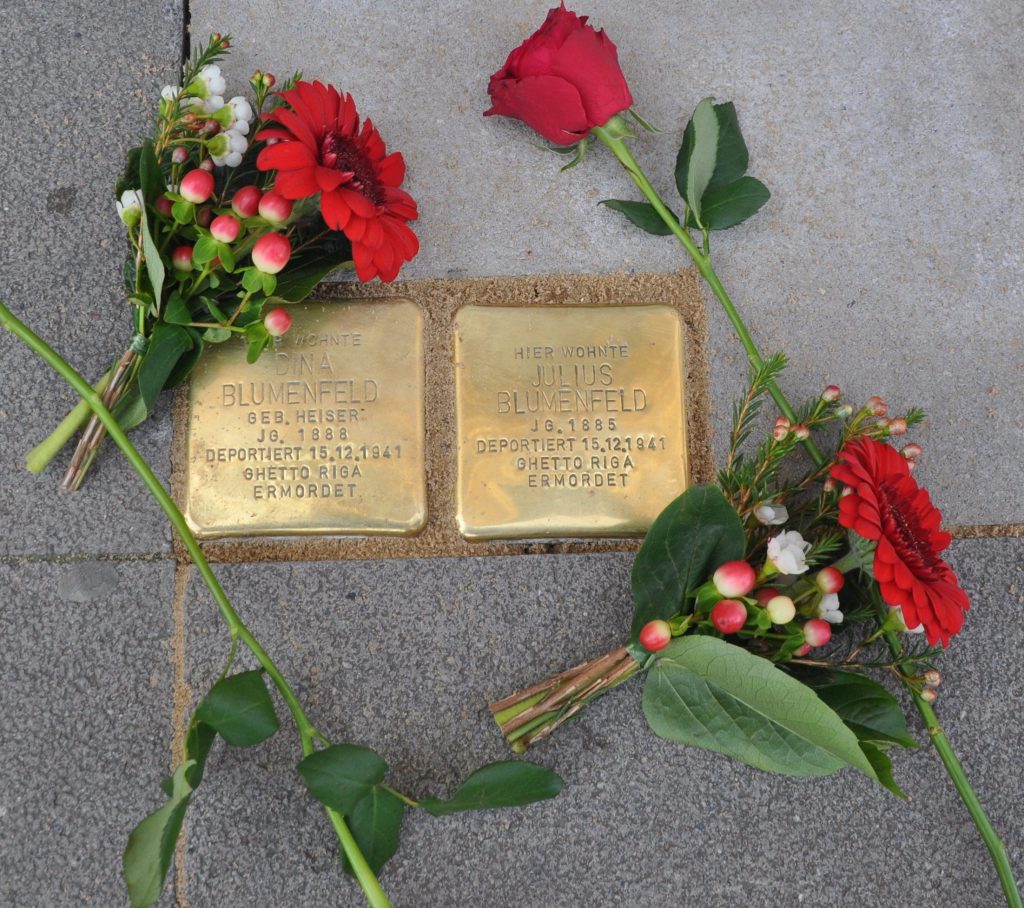
Am 30. Juni 2026 wurden vor dem Gebäude an der Goethestrasse, in dem die Familie Blumenfeld zuletzt noch freiwillig wohnte, Stolpersteine für Julius und Dina Blumenfeld-Heiser verlegt. Ein weiterer Beitrag ist hier.
- Standesamt Neustadt (Hessen), Geburtsnebenregister 1885 (HStAMR Best. 915 Nr. 6468), Blatt 16. ↩︎
- «Julius Blumenfeld», Einwohnermeldekarte der Stadt Hannover. ↩︎
- Adressbuch der Stadt Hannover 1901, S. 1196. ↩︎
- «Julius Blumenfeld», Einwohnermeldekarte der Stadt Hannover. ↩︎
- «Julius Blumenfeld», Einwohnermeldekarte der Stadt Hannover. ↩︎
- Brief von Julius, angefügt an den Brief seines Onkels Gerson Blumenfeld/George Bloomfield vom 1. Juli 1903. Kopie im Besitz des Autors. ↩︎
- Adressbuch der Stadt Hannover für 1910, Abteilung II, Seite 290. ↩︎
- Pferdebahn in der Brunnenstrasse, in: «Pyrmont damals», Friedrich Webel, 1989, Lizenz CC BY-SA 3.0 DE, https://pyrmontwiki.de/Datei:191x-Brunnenstra%C3%9Fe-Pferdebahn.jpg?uselang=de#Lizenz. ↩︎
- «Julius Blumenfeld», Einwohnermeldekarte der Stadt Hannover. ↩︎
- Heiratsregister Hoof 1912, Blatt 13, in: Standesamt Hoof Heiratsnebenregister 1912, Hessisches Staatsarchiv Marburg (HStAMR Best. 909 Nr. 5251) ↩︎
- Adressbuch, Stadt- und Geschäfts-Handbuch der Königlichen Haupt- und Residenzstadt Hannover, der Stadt Linden, sowie er Ortschaft Ricklingen und der Kolonie Leinhausen, Hannover 1913, S. III/44; Adressbuch, Stadt- und Geschäfts-Handbuch der Königlichen Haupt- und Residenzstadt Hannover und der Stadt Linden, Hannover 1914, S. III/45. ↩︎
- Meldekarte der Familie Blumenfeld-Heiser, Information übermittelt von Edel Sheridan-Quantz, Landeshauptstadt Hannover, Zentrale Angelegenheiten Kultur (41.03), ZeitZentrum Zivilcourage, im E-Mail vom 21. März 2022 an Richard J. Bloomfield. ↩︎
- U.S. Public Records Index, 1950-1993, Volume 2, in: Ancestry.com. ↩︎
- «Julius Blumenfeld», Einwohnermeldekarte der Stadt Hannover. ↩︎
- Adressbuch, Stadt- und Geschäfts-Handbuch von Hannover, Hannover 1921, S. III/292. ↩︎
- U.S., Social Security Death Index, 1935-2014, Number: 065-24-7357; Issue State: New York; Issue Date: Before 1951, in: Ancextry.com. ↩︎
- Steven Bloomfield an Richard J. Bloomfield (E-Mail), 30. Juli 2017. ↩︎
- Adressbuch der Stadt Hannover 1931, Abteilung III, Seite 26. ↩︎
- «Julius Blumenfeld», Einwohnermeldekarte der Stadt Hannover. Die Familie meldete sich Am Taubenfelde am 15. Oktober 1930. ↩︎
- «Julius Blumenfeld», Einwohnermeldekarte der Stadt Hannover. Die Familie meldete die Adressänderung am 1. April 1932. ↩︎
- Adressbuch der Stadt Hannover für das Jahr 1938, Hannover 1938, S. II/89. ↩︎
- «Julius Blumenfeld», Einwohnermeldekarte der Stadt Hannover. ↩︎
- «Julius Blumenfeld», Einwohnermeldekarte der Stadt Hannover. ↩︎
- Adressbuch der Stadt Hannover für das Jahr 1939, Hannover 1939, S. II/236. ↩︎
- Steven Bloomfield an Richard J. Bloomfield (E-Mail), 12. August 2017, 23.57h. ↩︎
- Steven Bloomfield an Richard J. Bloomfield (E-Mail), 12. August 2017, 23.57h. ↩︎
- Kentucky, Death Records, 1852-1964, in: Ancestry.com. ↩︎
- Aline Pennewaard an Richard J. Bloomfield (E-Mail), 25. Mai 2021. Aline Pennewaard ist Historikerin und fand Dinas Brief in den NIOD-Archiven in Amsterdam. ↩︎
- Heiratsnebenregister Standesamt Hoof 1905, (HStAMR Best. 909 Nr. 5244), Hessisches Staatsarchiv Marburg, Blatt 2. ↩︎
- Heiratsnebenregister Standesamt Hoof 1908, (HStAMR Best. 909 Nr. 5247), Hessisches Staatsarchiv Marburg, Blatt 9. ↩︎
- Jüdische Opfer der 2. Weltkrieg, Gemeinde Valkenburg-Houthem, in: Blik op de wereld, Joodse slachtoffers 2e WO gemeente Valkenburg-Houthem, https://www.blikopdewereld.nl/geschiedenis/vervolging-joden/provincie-limburg/1112-joodse-slachtoffers-2e-wo-gemeente-valkenburg-houthem. ↩︎
- Transport 15. Dezember 1941 von Hannover nach Riga, in: Emil Schorsch Collection 1841-1999, archive.org. ↩︎
- Deutschland Bundesarchiv Koblenz, Gedenkbuch – Opfer der Verfolgung der Juden unter der nationalsozialistischen Gewaltherrschaft in Deutschland 1933-1945, http://www.bundesarchiv.de/gedenkbuch/de844623 [2. Mai 2018]; Deutschland Bundesarchiv Koblenz, Gedenkbuch – Opfer der Verfolgung der Juden unter der nationalsozialistischen Gewaltherrschaft in Deutschland 1933-1945, http://www.bundesarchiv.de/gedenkbuch/de844611 [2. Mai 2018]. ↩︎
- Steven Bloomfield an Richard J. Bloomfield (E-Mail), 12. August 2017. ↩︎
- Schulze, Peter, Die Deportation aus Hannover am 15. Dezember 1941, in: Buch der Erinnerung. Die ins Baltikum deportierten deutschen, österreichischen und tschechoslowakischen Juden, Wolfgang Scheffler / Diana Schulle, 2 Bde., München 2003, Bd. 2, S. 765-768, hier S. 766. ↩︎
- Ebd. ↩︎
- Ebd. ↩︎
- Emil Schorsch Collection, AR 25103, List of Deported Jews, 1941-1943, 5/71, https://archive.org/details/emilschorsch_10_reel10/page/n957/mode/1up. ↩︎
- Dr. Edel Sheridan-Quantz, ZeitZentrum Zivilcourage, Text zu den Stolpersteinen für Dina Heiser und Julius Blumenfeld. ↩︎
- Foto, in: Pinterest, https://i.pinimg.com/564x/0c/60/4c/0c604cca73b14ac594361845e6b2eb94.jpg ↩︎
- 1934 hatte man die Synagoge saniert und als Turnsaal für jüdische Vereine hergerichtet. Nach der Zerstörung der neuen Synagoge im November 1938 wurde der Saal wieder für Gottesdienste benutzt. (Klaus Mlynek / Waldemar R. Röhrbein, Stadtlexikon Hannover. Von den Anfängen bis in die Gegenwart, Hannover 2009, S. 614.) ↩︎
- Klaus Mlynek / Waldemar R. Röhrbein, Stadtlexikon Hannover: Von den Anfängen bis in die Gegenwart, Hannover 2010, S. 326. ↩︎
- Schulze, Deportation aus Hannover, S. 766f. ↩︎
- Zitat aus einer nicht mehr aufgeschalteten Dokumentation, in: Erinnerung Zukunft in der Region Hannover, www.erinnerungundzukunft.de [22. August 2017]. ↩︎
- Dr. Edel Sheridan-Quantz, ZeitZentrum Zivilcourage, Text zu den Stolpersteinen für Dina Heiser und Julius Blumenfeld. ↩︎
- Schulze, Deportation aus Hannover, S. 768. ↩︎
- Ebd. ↩︎
- [Anzeige], in: Aufbau / Reconstruction, New York NY, Vol. XI-No. 24, 15. Juni 1945, S. 37. ↩︎
- [Anzeige], in: Aufbau / Reconstruction, New York NY, Vol. XI-No. 37, 14. September 1945, S. 19. ↩︎
- Schulze, Deportation aus Hannover, S. 768. ↩︎
- Vermerk auf der Meldekarte mit der Referenz 87 II 411/48. ↩︎


