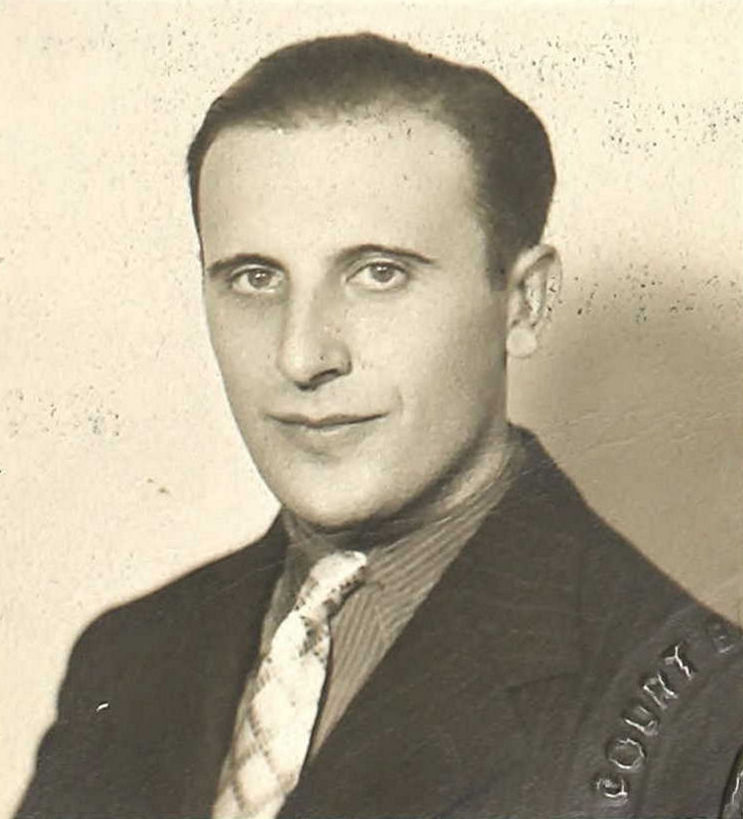
Julius Blumenfeld / Julian Bloomfield was the youngest son of Abraham Blumenfeld and Sophie Mansbach, born on January 2, 1910, in Momberg, Hesse, Germany.1 He emigrated to the United States with his mother Sophie Mansbach Blumenfeld, arriving in New York on board the “Manhattan” on March 19, 1936.2 They went to join Julian’s brother Hugo, who was living in Lexington, Kentucky.
After his arrival in America, Julian’s “first job was at Meyers [Meyers Brothers Inc., Jewish store owners] cutting riding hats,” according to his daughter Simone Bloomfield Salomon. “He made five dollars a week and ate an apple every day for lunch.”3
At some point, Julian “lived in a kind of boarding house…. Actually, he was sharing the bed [with another boarder, but] he didn’t know it because he couldn’t speak enough English…. He thought it was just his bedroom.”4 In the family, the story also circulated that Julian stayed for a time in the attic of his brother Hugo’s house.5
On June 10, 1941, Julian became a US citizen6 and left Germany definitely behind him. Simone recalls in an interview with Nora Rose Moosnick that he tried to forget about his native country:7
“When he left Germany, that was the end of it. And in fact, he would not even speak German to people who came into the store. One time he said he tried to help somebody who couldn’t speak English and they said, ‘Oh, you speak nice German. Where did you learn?’ And he said at school. He also had trouble remembering. His mother told him not to tell anyone [about his father’s death], and he never even told my mother. So he kept that in, and he kept having nightmares.”
“We [Simone and her sisters] were afraid to ask [about the past in Germany]. It was just something you knew and didn’t talk about. She [his wife Gishie] never talked about it, and then I found out later when we took Dad back to Germany that there were things that he never even told my mother, in sixty-five years, never told anyone.”
Julian registered with the US Army on July 14, 1942, and was called up the next month.8 He did his basic training at the Quartermaster Replacement Training Center in Fort Warren, near Cheyenne, Wyoming.9
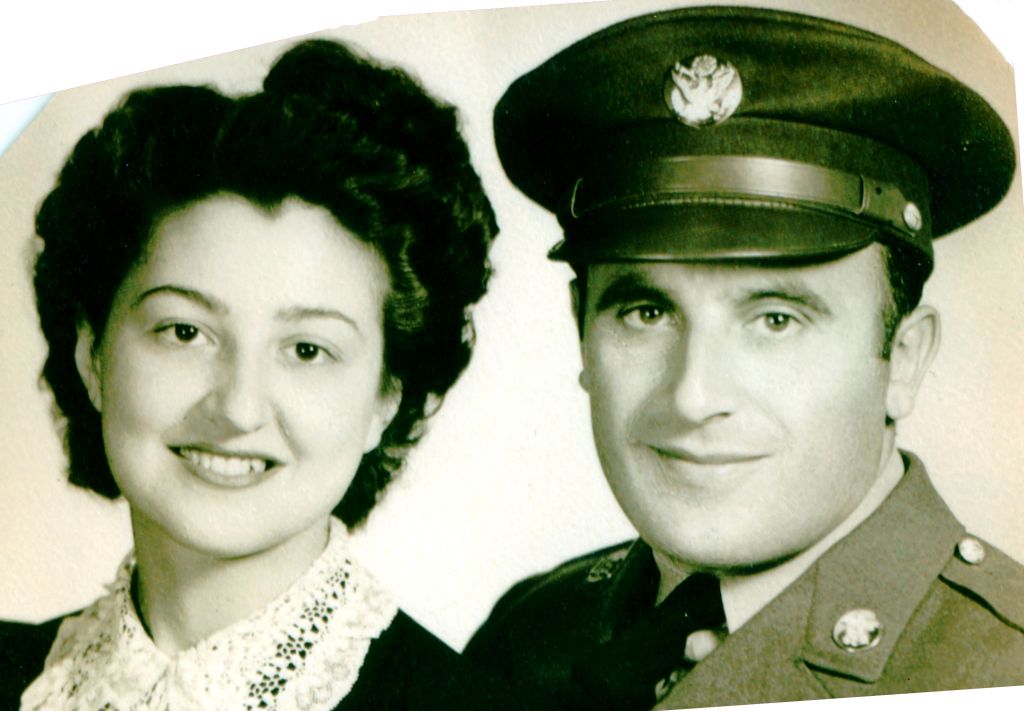
Just two months before being called up, Julian married Gishie Bederman, born July 23, 1921. Gishie, graduated with a PE major at the University of Kentucky and married Julian on the same day: May 30, 1942.10 The young bride followed her soldier-husband to several military bases in the United States, writing letters to the local paper about her experiences.11 Daughter Simone recounts that Gishie also participated in the war effort. “She was a Rosie the Riveter when he was in California. She was proud of being one…. When he got shipped overseas, that’s when she came home.”12
While Julian was stationed in North Africa, Gishie gave birth to their first child, son Arnold. The infant, born September 18, 1943, died the same day13 and is buried in Lexington in the same grave as Gishie’s sister, Tilly (1916-1920).14
On April 10, 1944, Gishie’s father, Samuel, died unexpectedly.15 His wife, Sadie, née Oshry, and Gishie took over the shoe store that the elder Bedermans had opened around 1911.16 When Julian returned after almost four years of service in North Africa and Sardinia, he and Gishie took over the business, the New Way Shoe Store.
In two letters Julian’s mother, Sophie, describes the business: “Julian has a shoe store and, at the same time, two men who only do repairs, but everything with machines. It’s going well. His wife’s mother also helps out.”17 He sells “only shoes for men. No children’s shoes…. People come in and have their shoes fixed while they wait. They then put them on and go on their way. Everything is easier for people here.”18
Simone describes the repairmen in her interview with Nora Rose Moosnick: “It was hard to find a shoe repairman that was reliable. We were always scared of them. Dad was always bailing them out of jail. We were always scared that the shoe repairman was going to kill Dad. He tried to kill his wife, slit her throat, and Dad bailed him out.”19
According to Simone, the store was the main element of her parents’ lives. “They were gone there all day, and then they’d come home, they’d talk about it. They’d talk about the store, the customers, the nice ones, and the ones that weren’t so nice. They’d rehash the whole day. They worked together all day and then they’d come home and talk about the customers and the store…. For years, there was never any vacation. We never took a vacation ever. They did not feel that they could ever leave the store or leave it with anybody.”20
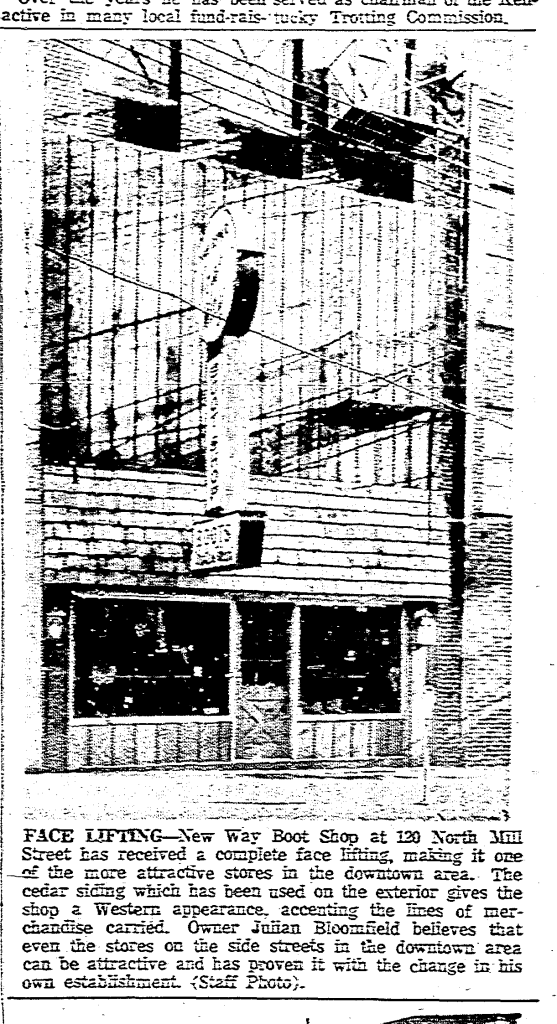
To augment their main shoe store on the corner of Mill and Short Streets in downtown Lexington, Julian and Gishie opened a branch store for shoe repair in the Chevy Chase shopping center in August 1953.21 Later they opened branches in the Southland (March 1962)22 and Eastland (December 1962)23 shopping centers. However, only the store downtown sold merchandise.24 For a time, Bloomfields also operated a liquor store in the Drake Hotel diagonally across the street from their downtown store.25
In her interview with Nora Rose Moosnick Simone gives some insight into her parents’ very different characters: Gishie “was a lot more worried about money and what they had. …[S]he was actually much more interested in business and investments and stuff than Dad. He’d let Mom take care of that part. He was more into flowers and stuff. He liked aesthetics. He liked gardening. He ironed his own shirts. He was the only one in the family that could iron. … He was very neat, very neat. It’s funny because even in later years, she would buy stock; she was the one that really worried about all that. … He was just happy to go to work and run the business and let her take care of everything else. Well, I think Dad paid the bills, but she was always figuring things out and what they should invest in. She also went and started buying properties and renting things out.”26
Mother and Grandmother Sophie wrote the Lotter family that she was excited about the birth of Julian and Gishie’s daughters, Simone (born 1946),27 and Janice (born 1948),28 and would have liked to have had them more at her house: “The older girl spends two afternoons a week with me[. The two girls] are a great joy to us all.”29 She was happily looking forward to the birth of Julian and Gishie’s third child. In March 1950 she wrote: “A third baby is arriving soon…”30 This time she was hoping for a grandson: “… possibly a boy.” On August 6, 1950, a third girl, Lynn, was born.31
Julian and Gishie led a successful fight against developers in their neighborhood, preventing the construction of buildings that didn’t fit into the residential setting. “We lived on Idle Hour Drive,” Simone remembers, “and they left … two lots … for development. [My parents] didn’t want anything commercial there like a gas station…. They spent a lot of time and money on the neighborhood. Finally, [developers] were going to put up a bank, and [my parents] didn’t even want the bank…. They fought years and years…. They kept anything bad from going up there.”32
“Dad was always religious. He’d go to services. He’d daven [pray] every morning,” Simone recalls. “My dad was kosher when he grew up, … but my mom was so on the opposite end of the spectrum. They ate everything.” “Mom was not religious at all. She was very bored by [it]. She’d go [to synagogue] on the holidays and … [then s]he’d get out her lipstick and put it on while she was sitting there, not too interested. She was so put out and thought that it was a waste of time. She’d rather be vacuuming or something.”33
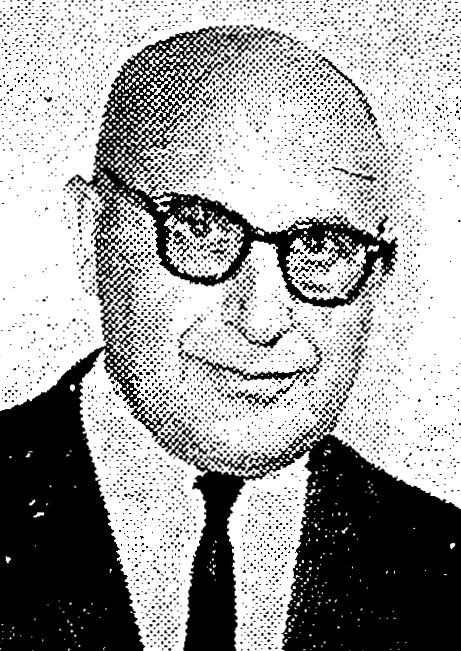
Julian was actively involved in the life of the Ohavay Zion Synagogue in Lexington. He served as financial secretary, was on the board of trustees,34 and was elected to the office of second and then first vice president of the synagogue.35 For a time, Julian was treasurer of the Ohavay Zion Men’s Club.36 Gishie and Julian were also involved many times with the sale of Israel Bonds37 and were members of the La Sertoma service club.38 Although not religious, Gishie was active in the social life of the Ohavay Zion Synagogue in the religious school,39 and in the Ohavay Zion Sisterhood, even serving as president.40
After retirement, Julian and Gishie moved to Bradenton, Florida, where Gishie died on January 1, 1995.41 Sometime after 2002, Julian returned to Lexington where he died on April 12, 2007.42 Both were buried in the cemetery in Lexington, Kentucky.
- Julian Bloomfield, Declaration of Intention, October 30, 1938, in: Ancestry.com. ↩︎
- Year: 1936; Arrival: New York, New York; Microfilm Serial: T715, 1897-1957; Microfilm Roll: Roll 5778; Line: 3; Page Number: 33, in: Ancestry.com. ↩︎
- Moosnick, Nora Rose, Arab and Jewish Women in Kentucky. Stories of Accommodation and Audacity, Lexington, Kentucky, 2012, in: Google digitalized edition, p. 119-120. ↩︎
- Moosnick, Arab and Jewish Women, p. 120. ↩︎
- Simone Salomon-Bloomfield to Richard J. Bloomfield (email), January 11, 2018. ↩︎
- Kentucky, Naturalization Records, 1906-1991, in: Ancestry.com, The National Archives at Atlanta; Atlanta, Georgia; Petitions for Naturalization, complied 1922 – 1930; NAU: 5637782; Record Group Title: Records of District Courts of the United States; Record Group Number: 21, [05.07.2018]. ↩︎
- Moosnick, Arab and Jewish Women, p. 119-120. ↩︎
- [Anonymous], Kentuckiana Furnishes Large Contingent for Marine Corps, in: The Courier-Journal, Louisville KY, August 13, 1942, p. 3. ↩︎
- U.S., World War II Army Enlistment Records, 1938-1946, in Ancestry.com, [05.07.2018]. ↩︎
- Moosnick, Arab and Jewish Women, p. 119. ↩︎
- Ell Bee, Four Bits. Fugitive!, in: The Lexington Leader, Lexington KY, 25. September 25, 1942, p. 1; Ell Bee, Four Bits. Safe?, in: The Lexington Leader, Lexington KY, Oktober 10, 1942, p. 1. ↩︎
- Moosnick, Arab and Jewish Women, p. 121. ↩︎
- [Anonymous], Funerals. Bloomfield Infant, in: The Lexington Herald, Lexington KY, September 19, 1943, p. 2. ↩︎
- Arnold Bloomfield, in: Find A Grave, [10. January 2018]. ↩︎
- Kentucky, USA, Register of Deaths, 1852-1965, in: Ancestry.com. ↩︎
- Moosnick, Arab and Jewish Women, Chapter 3, Maternal Echoes. ↩︎
- Sophie Bloomfield-Mansbach to the Lotter family in Momberg, October 1946, A copy of the letter received from Kunibert Schmitt, Momberg. ↩︎
- Sophie Bloomfield-Mansbach and Frieda Weinberg-Bloomfield to the Lotter family, undated, A copy of the letter received from Kunibert Schmitt, Momberg. ↩︎
- Moosnick, Arab and Jewish Women, p. 122. ↩︎
- Moosnick, Arab and Jewish Women, p. 123. ↩︎
- Lee Harris, Strictly Business. 5,795 Board EAL Here; New Shoe Shop Opened, in: Sunday Herald-Leader, Lexington KY, August 23, 1953, p. 37. ↩︎
- [Anonymous], New Way Shoe Store Opens New Shop At 353 Southland, in: The Lexington Leader, Lexington KY, March 24, 1962, p. 5. ↩︎
- [Anonymous], New Way Has ‹While You Wait› Service, in: The Lexington Herald, Lexington KY, 17. December 17, 1962, p. 7. ↩︎
- Simone Salomon-Bloomfield to Richard J. Bloomfield (email), December 22, 2017, 7.45 p.m. ↩︎
- Simone Salomon-Bloomfield to Richard J. Bloomfield (email), 22. December 22, 2017, 7.45 p.m; [Anonymous], LIQUOR LICENSE NOTICE, in: The Lexington Herald, Lexington KY, May 3, 1958, S. 12. ↩︎
- Moosnick, Arab and Jewish Women, p. 127. ↩︎
- Kentucky, USA, Geburtenindex, 1911–1999, in: Ancestry.com. ↩︎
- Kentucky, USA, Heiratsindex, 1973–1999, in: Ancestry.com. ↩︎
- Sophie Bloomfield-Mansbach to the Lotter family, November 1949, copy provided by Kunibert Schmitt, Momberg. ↩︎
- Sophie Bloomfield-Mansbach to the Lotter family, March 1950, copy provided by Kunibert Schmitt, Momberg. ↩︎
- Kentucky, USA, Geburtenindex, 1911–1999, in: Ancestry.com. ↩︎
- Moosnick, Arab and Jewish Women, p. 135. ↩︎
- Moosnick, Arab and Jewish Women, p. 131. ↩︎
- [Anonymous], Ohavay Zion To Install Officers, in: The Lexington Herald, Lexington KY, May, 28, 1961, p. 42. ↩︎
- [Anonymous], Cooper Is Elected At Ohavay Zion, in: The Lexington Herald, Lexington KY, May 20, 1963, p. 10; [Anonymous], Ground-Breaking Ceremonies Held, in: The Lexington Leader, Lexington KY, August 3, 1964, p. 19. ↩︎
- [Anonymous], Stein Named President Of Congregation, in: The Lexington Leader, Lexington KY, May 25, 1959, p. 12. ↩︎
- [Anonymous], Bond Show Is Planned, in: The Lexington Herald, Lexington KY, June 16, 1966, p. 23; [Anonymous], Israel Bond Drive Dinner Is Planned Here Sept. 12, in: Sunday Herald-Leader, Lexington KY, August 29, 1971, p. 57. ↩︎
- Sertoma International is a service club. The name is an acronym for Service to Mankind. The clubs in U.S. and Canada sponsor community projects to promote freedom and democracy, to assist youth, and to benefit a variety of other local community needs as identified by individual clubs.
[Anonymous], Modernizing Main Streets Subject Of Sertoma Talk, in: The Lexington Leader, Lexington KY, March 15, 1954, p. 6.
[Anonymous], Sertoma Club Plans ‹White Elephant› Sale, in: The Lexington Leader, Lexington KY,May 4, 1954, p. 8.
[Anonymous], New Officers Are Installed By La Sertoma, in: The Lexington Herald, Lexington KY, June 9, 1954, p. 6. ↩︎ - [Anonymous], Ohava Zion Pupils To Honor Mothers, in: The Lexington Leader, Lexington KY, May 7, 1953, p. 42. ↩︎
- Herald Photo Legend, OHAVA ZION SISTERHOOD TO INSTALL OFFICERS, in: The Lexington Herald, Lexington KY, May 21, 1953, p. 12.
[Anonymous], Ohava Zion Sisterhood To Meet Tuesday, in: Sunday Herald-Leader, Lexington KY, September 16, 1956, p. 26.
[Anonymous], Announcements. Ohava Zion Bazaar, in: Sunday Herald-Leader, Lexington KY, March 17, 1957, S. 24.
[Anonymous], Jewish Women Groups Plan Joint Meeting, in: Sunday Herald-Leader, Lexington, KY, November 29, 1953, p. 18.
[Anonymous], Sisterhood To Hold Luncheon Meeting, in: The Lexington Leader, Lexington KY, September 14, 1957, p. 2.
[Anonymous], ‹Happy› To Speak At Dinner Here, in: The Lexington Leader, Lexington KY, May 16, 1962, p. 13. ↩︎ - [Anonymous], BLOOMFIELD, in: The Lexington Herald-Leader, Lexington KY, January 3, 1995, p. 12. ↩︎
- [Anonymous], LOCAL, BLOOMFIELD, in: The Lexington Herald-Leader, April 13, 2007, p. 18. ↩︎
 Blumenfeld Family Stories
Great bio. Thanks! One more I can check off the list of my “people to do.” 🙂
LikeLike