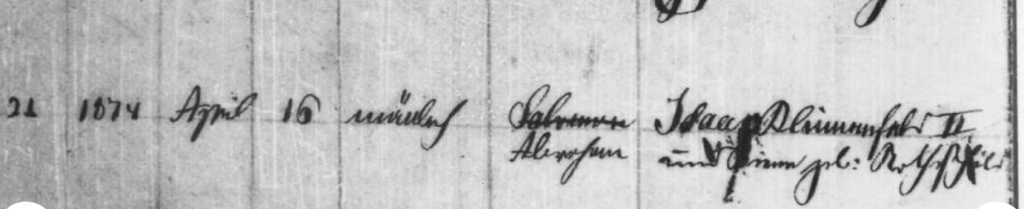
Abraham Blumenfeld, Isaac Blumenfeld and Biene née Rothschild’s third child, was born in Momberg on April 16, 1874.1 Like father, like son. Abraham became a cattle merchant.
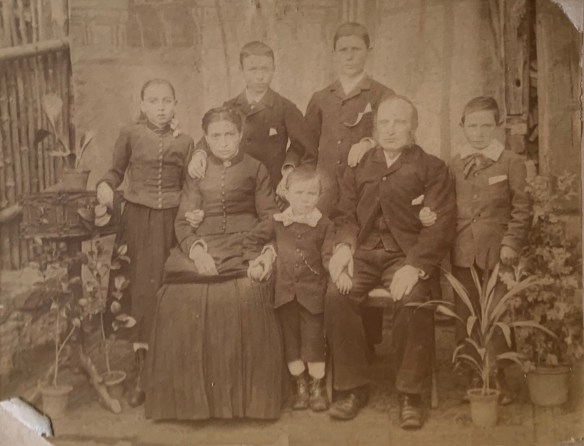
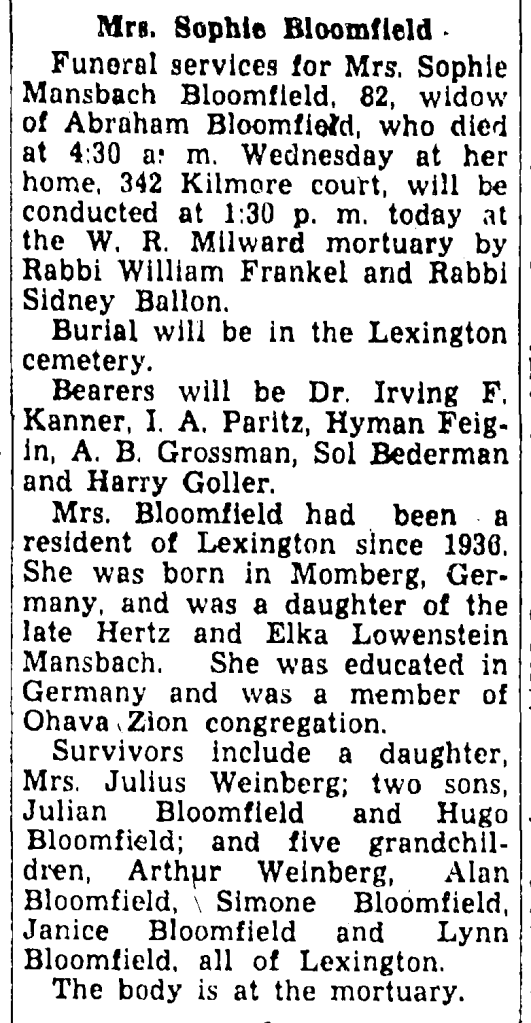
On April 14, 1903, he married Süsschen/Sophie Mansbach in Obervorschütz.2 Today Obervorschütz is the southernmost part of the town of Gudensberg in the North Hessian district Schwalm-Eder. Sophie Mansbach was the daughter of Herz Mansbach and Elkel née Löwenstein from Maden (Gudensberg) and was born on March 17, 1870.3 Sophe and Abraham had three children: Frieda (1904-1991), Hugo (1905-1986) and Julius (1910-2007).


Son Hugo was the first member of the family to emigrate. His uncle Joe Bloomfield brought him to the United States in 1923 when he was just 17.4 After Abraham’s murder in 1931 – described in a separate post here — his wife Sophie and their son Julius left for Kentucky in 19365 to be followed by daughter Frieda, her husband Josef Julius Weinberg and their son Arthur in 1937.6
Before emigrating to the United States, Sophie sold the house known as “Eisigs Haus” that she and Abraham had taken over from his parents Isaac Blumenfeld and Biene née Rothschild. The contract for purchase (below) provided by Kunibert Schmitt† of Momberg indicates that Sophie sold the house number 46 to her neighbor Heinrich Lotter on February 3rd for 3,000 Reichsmark.The house was razed in 1958 by the neighboring family Lotter, which built a stall on the property.7

In her little book Some memories of my youth and concentration camps Gisela Spier Cohen describes her visits with Sophie Blumenfeld and “Esigs Haus” that Sophie and Julius had to leave: “Her living room was furnished in an old-fashioned style, yet beautiful. She had a gramophone which she played for me. I liked watching the metal teeth of the gramophone while they played the same melody over and over. She made raisin wine, and when I had the opportunity to visit her on Shabbos or a holiday, I always got a little glass of this delicious raisin wine. Her house must have been very old. When you entered the house, there was a well in the middle of the corridor. It (almost) looked like a modern-day swimming pool, (of course) much smaller. Some steps led down to the water. The well was always closed with a trap door.”8
Even though they were not able to take much luggage with them when they emigrated, Sophie couldn’t bear to leave her Shabbat candlesticks behind.9 Mother and son had learned the truth about Abraham’s death from a Christian in Momberg before their emigration. However, they “suppressed” this knowledge and decided not to tell anyone that he had been murdered. Julius even knew the identity of the murderer! It wasn’t until 60 years after the fact that Julius divulged the truth to his family. Julius and his mother told everyone that Abraham had been killed in a train wreck.10
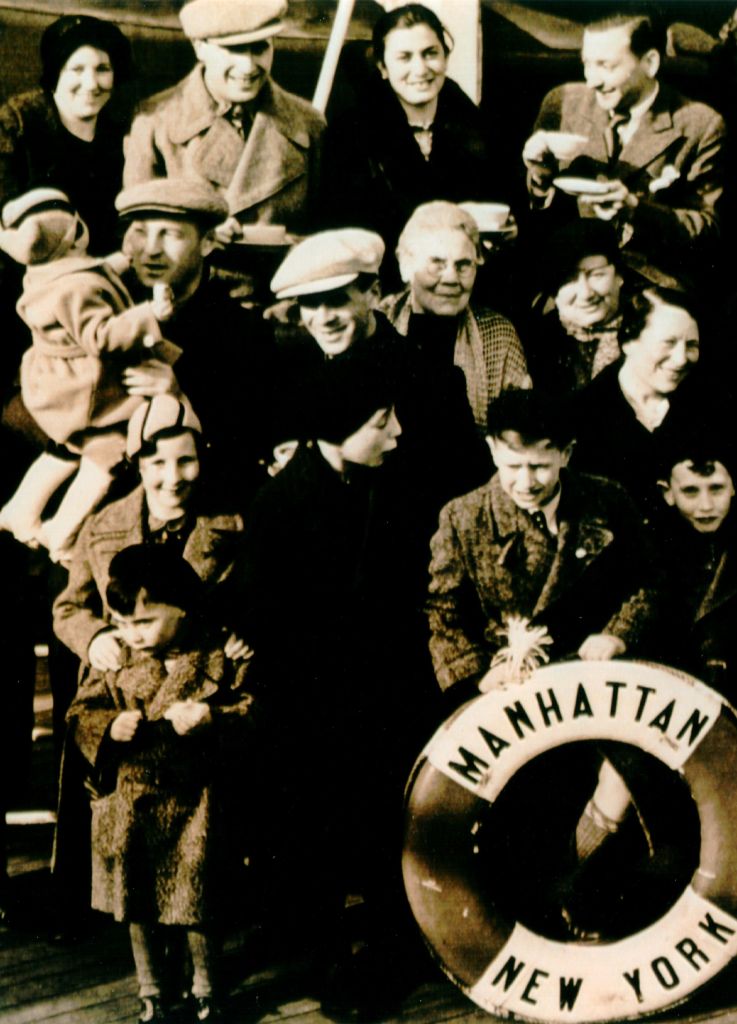
Simone Bloomfield Salomon, Julius’s oldest daughter, related in an interview with Nora Rose Moosnick, “His mother told him not to tell anyone [about his father’s death], and he never even told my mother. So he kept that in, and he kept having nightmares.”11 Simone and her sisters Janice and Lynn were afraid to ask about the past.
At first, Sophie and her son lived together at 386 South Upper Street in Lexington, Kentucky, moving around 1939 to 130 Ransom Avenue. Here they shared the house with Sophie’s daughter Frieda, her husband Julius Weinberg, and their son Arthur, who had left Germany to come to Lexington in May 1937. A year later they all moved to 342 Kilmore Court. Julius was called up for military service shortly after his marriage to Gishie Bederman on May 30, 1942. Sophie remained with her daughter until her death in 1951.
In a letter to their former neighbors in Momberg written about 1946, Sophie’s daughter, Frieda, relates that her mother had acclimated herself well to life in Lexington, Kentucky: “My mother can communicate well with the neighbors, even if her English is not really perfect. When one is older, it is very difficult to learn a new language. But she manages to deal with everything quite well, even the telephone. She also can read the newspaper well. A person can get used to anything.”12
“I take care of the kitchen and do whatever else I can. I enjoy doing handicraft,” Sophie writes to the family Lotter in Momberg.13 The candlesticks that she had brought from Germany had more than just symbolic value. In reference to her faith, Sophie writes: “Now, before Easter, we have a lot of work. I do everything as I am accustomed to and follow my religion as before.”14 She was excited about the birth of Julius and Gishie’s daughters, Simone (born 1946), and Janice (born 1948), and would have liked to have had them more at her house: “The older girl spends two afternoons a week with me[. The two girls] are a great joy to us all.”15 She was happily looking forward to the birth of Julius and Gishie’s third child. In March 1950 she wrote: “A third baby is arriving soon…”16 This time she was hoping for a grandson: “… possibly a boy.” On August 6, 1950, a third girl, Lynn, was born.
In the six still-existing letters to their former neighbors, Sophie and Frieda describe the frequent contact that they have to their German friends and relatives now scattered across the globe and how they, when necessary, send care packages. In her memoirs, Gisela Spier Cohen writes: “After the war, Aunt Sophie found me and kept in touch with me wherever I was. She wrote a letter of encouragement because she knew that I had lost my entire family and was completely on my own. Her letters reached me in various places, wherever I happened to be, and these letters gave me strength. I even got parcels from her.”17
The murdering of many family members and friends weighed heavily upon mother and daughter. Once, Sophie expressed her anger: “All of these people are now scattered all over the world. And why? Because of just one man: Hitler. They should have chopped his head off right at the beginning.”18
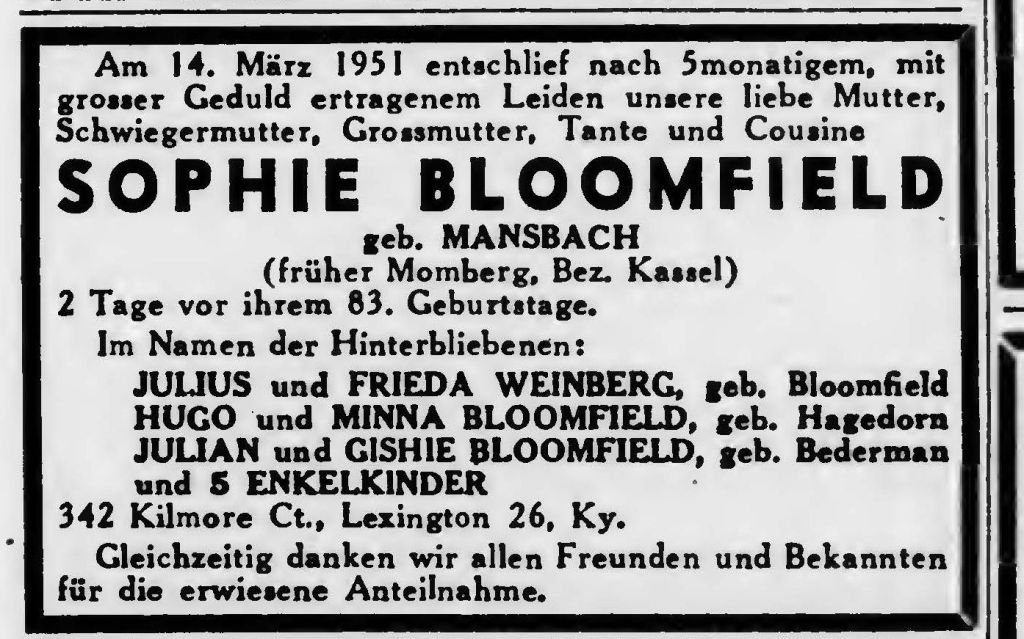
Near the end of 1949, Sophie fell and broke a hip. As with so many other older people, this accident was a sign of the beginning of the end. At about this time, she began to suffer from heart disease. On March 14, 1951, she died from cancer of the gallbladder.19 The death announcement in Aufbau,20 the German-language immigrants’ newspaper, contains a mistake: Sophie Mansbach was born in 1870 and not 1868.
- Geburtsregister der Juden von Momberg (Neustadt) 1850-1874, HHStAW Abt. 365 Nr. 608. ↩︎
- Standesamt Obervorschütz Heiratsnebenregister 1903 HStAMR Best. 920 Nr. 6672. ↩︎
- Geburtsregister der Juden von Gudensberg 1824-1874 HHStAW Abt. 365 Nr. 384. ↩︎
- New York, Passenger Lists, 1820-1957, Year: 1923; Arrival: New York, New York; Microfilm Serial: T715, 1897-1957; Microfilm Roll: Roll 3425; Line: 30; Page Number: 47, in: Ancestry.com. ↩︎
- New York, Passenger Lists, 1820-1957, Year: 1936; Arrival: New York, New York; Microfilm Serial: T715, 1897-1957; Microfilm Roll: Roll 5778; Line: 4; Page Number: 33, in: Ancestry.com. ↩︎
- New York, Passenger Lists, 1820-1957, Year: 1937; Arrival: New York, New York; Microfilm Serial: T715, 1897-1957; Microfilm Roll: Roll 5983; Line: 10; Page Number: 32, in: Ancestry.com. ↩︎
- Kunibert Schmitt†, Momberg, to Richard J. Bloomfield (email), August 28, 2017. ↩︎
- Spier Cohen, Gisela, Aus den Erinnerungen an Kindheit und Konzentrationslager, Marburg, 1994, p. 9. ↩︎
- Barbara Aiello, Stories from the Holocaust. Holocaust Remembrance Day in Europe. January 27, 2007. Julian Bloomfield, http://www.rabbibarbara.com [27.01.2007]. ↩︎
- Simone Bloomfield Salomon to Richard J. Bloomfield (email), August 14, 2017, 4:48 a.m.. ↩︎
- Steven Bloomfield to Richard J. Bloomfield (letter), January 18, 1996. ↩︎
- Sophie Blumenfeld-Mansbach and Frieda Bloomfield Weinberg to the Lotter family, undated letter, copy provided by Kunibert Schmitt†, Momberg. ↩︎
- Sophie Bloomfield-Mansbach to the Lotter family, October 1946, copy provided by Kunibert Schmitt†, Momberg. ↩︎
- Sophie Bloomfield-Mansbach to the Lotter family, March 1950, copy provided by Kunibert Schmitt†, Momberg. ↩︎
- Sophie Bloomfield-Mansbach to the Lotter family, November 1949, copy provided by Kunibert Schmitt†, Momberg. ↩︎
- Sophie Bloomfield-Mansbach to the Lotter family, March 1950, copy provided by Kunibert Schmitt†, Momberg. ↩︎
- Spier Cohen, Erinnerungen, p. 9f. ↩︎
- Sophie Bloomfield-Mansbach and Frieda Bloomfield Weinberg to the Lotter family, March 1948, copy provided by Kunibert Schmitt†, Momberg. ↩︎
- Kentucky, Death Records, 1852-1964, in: Ancestry.com. ↩︎
- [Obituary], in: Aufbau / Reconstruction. An American Weekly Published in New York, New York NY, Vol. XVII-No. 15, April 13, 1951, p. 30. ↩︎
 Blumenfeld Family Stories
Thanks, Richard, for this post about yet another Blumenfeld. Have we figured out how Sophie Mansbach of Maden was related to my Mansbach relatives from Maden? I need to see if I can find the connection. I’ll email you and see what you have.
LikeLike
Pingback: Frieda Blumenfeld and Julius Weinberg | Blumenfeld Family Stories