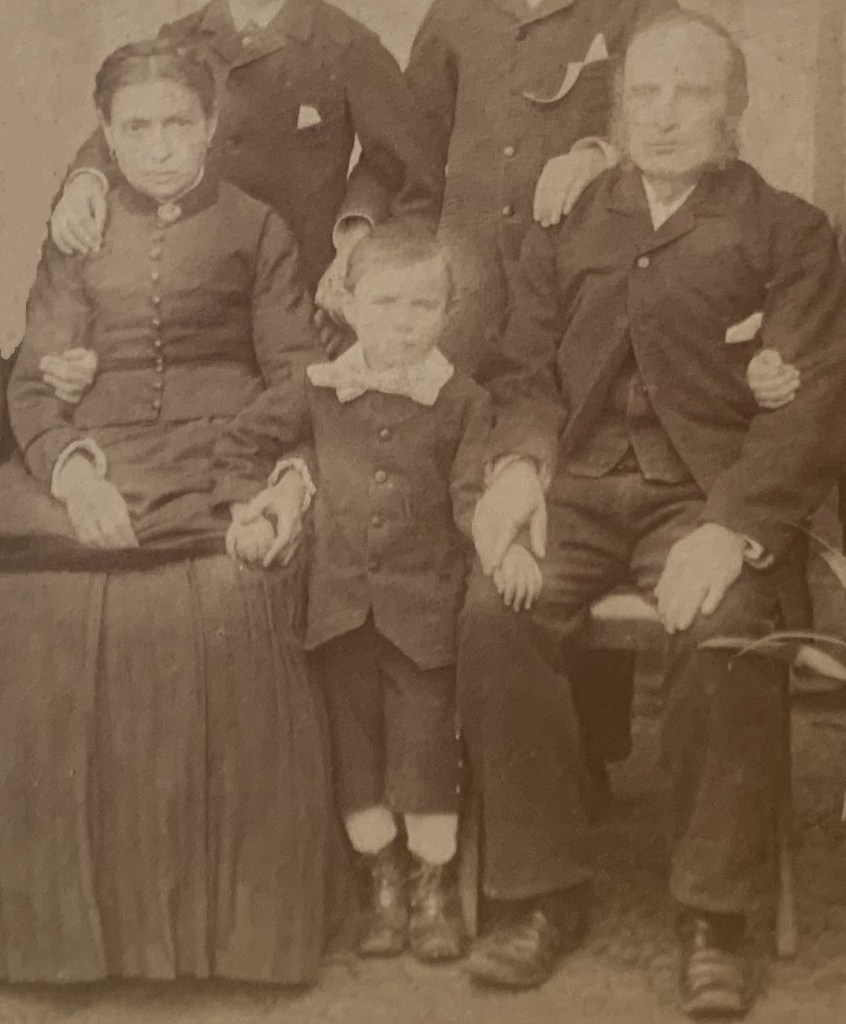
Julius Blumenfeld, born on February 21, 1885, was the youngest child of Isaac Blumenfeld and Bienchen, née Rothschild.1 We have no information about Julius until the 18-year-old butcher wrote to his brothers in America in 1903 that he was living in Hannover but was thinking of taking a job elsewhere – perhaps in Frankfurt.2
On September 9, 1912, Julius married Dina Heiser, born on March 14, 1888, daughter of “the married couple, master baker Isaack Heiser, residing in Hoof, and Jettchen, née Müller, last residing in Hoof [Hessen].”3
The newlyweds moved to Hannover, where Julius and Dina initially lived at Schlovinstrasse 9 in the city center. On the ground floor, Julius ran a butcher shop (Schlachterei).

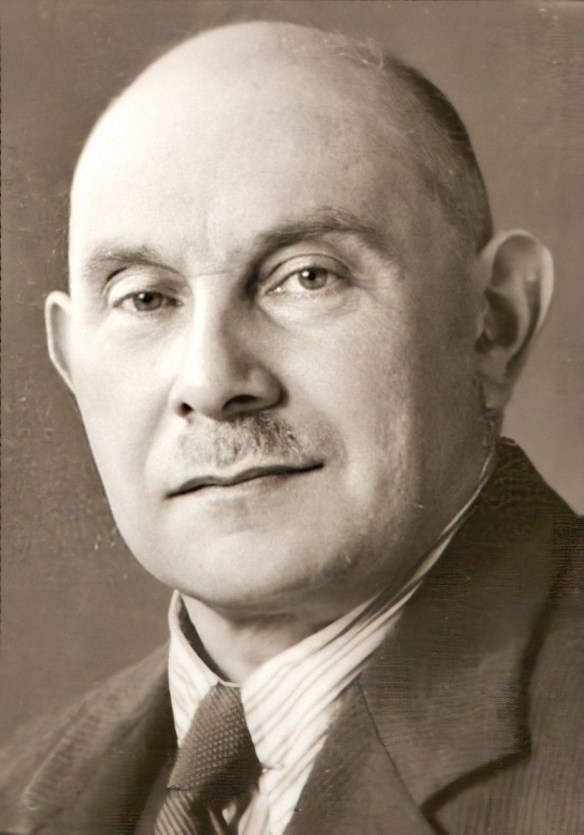
Julius and Dina’s first child, Jakob Heinz, was born on February 25, 1914.4 Their daughter Ilse was born on February 5, 1917.5
By 1920 at the latest, the family and business had moved to Nikolaistrasse 2. The exact date cannot be determined because there is no address book online for the years 1918 and 1919.6 Julius bought the four-story building on the corner of Nikolaistrasse and Georgstrasse from his fellow butcher Paul Gerdtz.7
Werner, the third of the three children of the Blumenfeld-Heiser couple, was born on December 9, 1921.8 The business was doing well and enabled the family to take vacations, pay for music lessons and send the children Heinz, Ilse (later Stein) and Werner to private school.9
In 1930, Julius sold the building on Nikolaistrasse to the butcher Fritz Sender and moved to Goethestrasse 39, where the family rented a shop and an apartment.10 After two years, they moved into an apartment on the second floor across the street at Goethestrasse 40.11
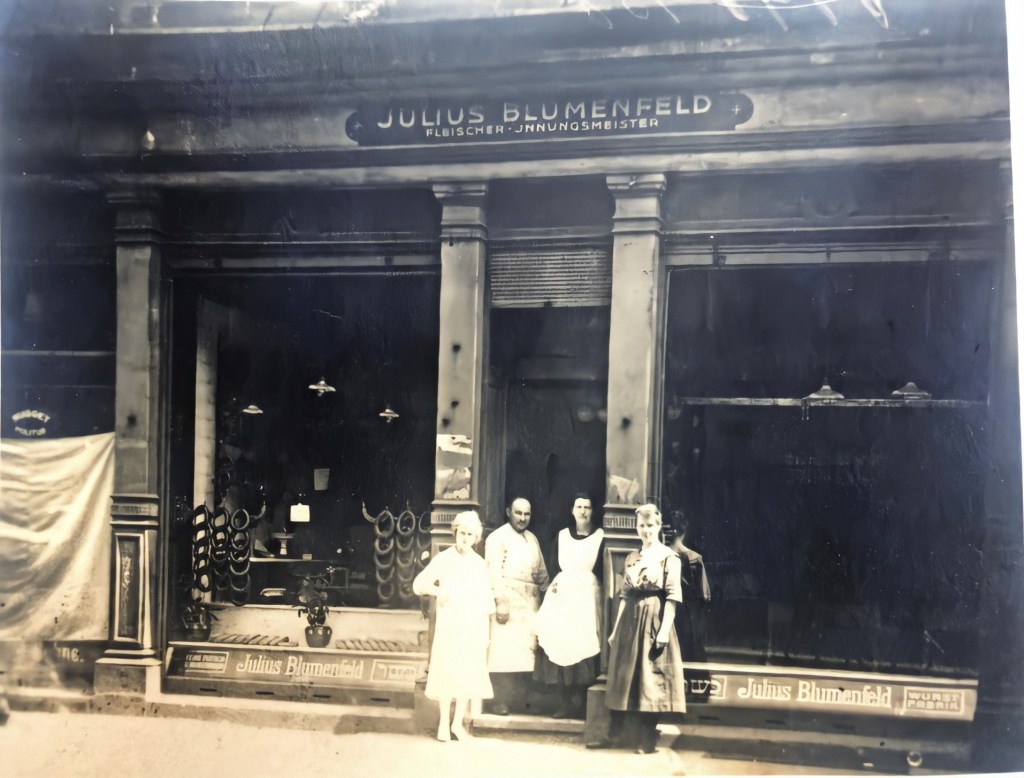
The Aryanization of Jewish businesses forced Julius to sell or hand over his shop to the butcher Hermann Kesten in 1937.12 Nazi legislation also forced the Blumenfeld family to give up their apartment. They had to move first to Georgstrasse 5113 and then to a house at Schmiedestrasse 17. According to the address book, 28 individuals or families lived in the five-story building on Schmiedestrasse! Deprived of his profession, the family ran a lunch counter, presumably in their own apartment, to earn some money.14
Julius and Dina recognized the impending danger and brought their three children, Heinz, Ilse and Werner, to safety. Daughter Ilse, who was allowed to emigrate to America with the support of her uncle Joseph in New York, tried to organize her parents’ departure from Germany. Her employer drove her by car to Winchester, Kentucky, where she wanted to meet her two uncles, Solomon and Levi. She wanted to ask them to act as sponsors for her parents, which would enable them to enter the United States. At that time, in June 1938, Salomon was on his honeymoon with his second wife, Elsie Kann Marx.15 Ilse met with Levi and his daughter Miriam.16 Levi was ill, suffering from locomotor ataxia since about 1926, a disease of the musculoskeletal system, and was confined to a wheelchair.17 Nothing came of her plan.
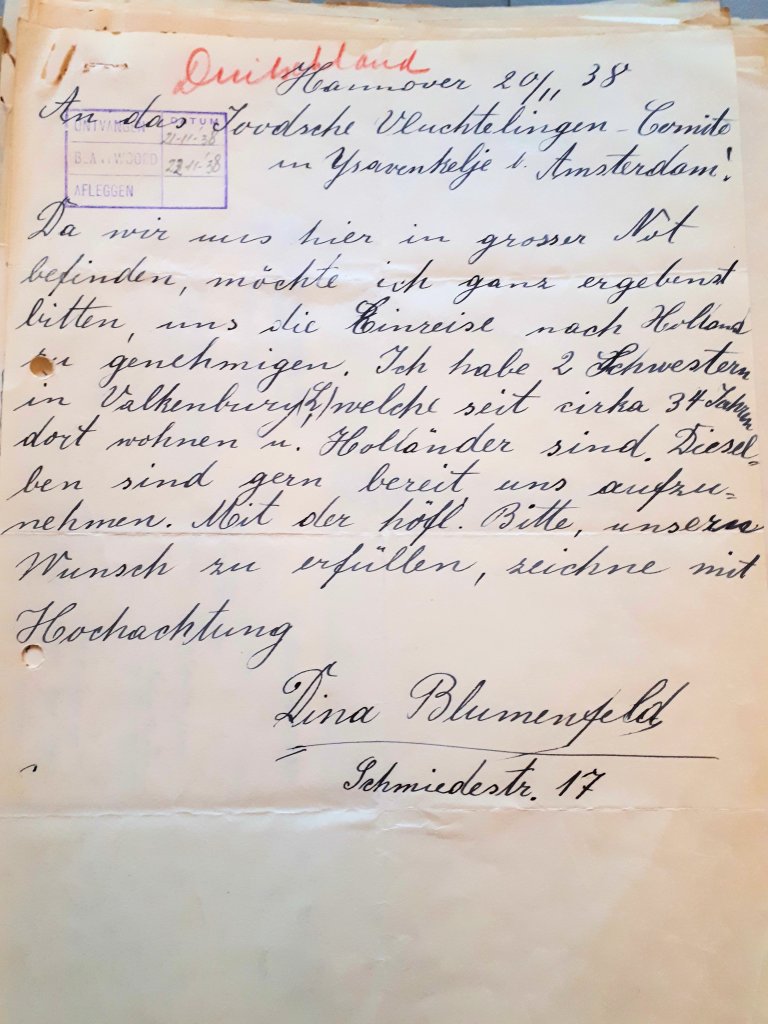
On November 20, 1938, Dina Blumenfeld wrote to the Jewish Refugee Committee in Amsterdam: “Since we are in great need here, I would like to humbly request that you allow us to enter the Netherlands. I have two sisters in Valkenburg who have been living there for about 34 years and are Dutch. They are willing to take us in. With the humble request to fulfill our wish, I respectfully sign, Dina Blumenfeld, Schmiedestr. 17.” Her request was denied. Dina’s sisters Mathilde and Bertha were married to the brothers Bernhard and Joseph Benedik (or Benedic), who were born in Schimmert, Netherlands. Fleeing to the Netherlands would not have offered Dina and Julius any lasting security. Mathilde and Bernhard and Bertha and Joseph Benedik were murdered in the Sobibor extermination camp in Poland.18
Julius and Dina’s names appear on a list of Jews who were to be deported from Hannover to the Riga Ghetto on December 15, 1941. A court in Hannover declared Julius and Dina dead on May 8, 1945.19
A school friend of daughter Ilse, Edith (married name Goldstrom), who had been in the ghetto with Julius and Dina, survived and was able to provide more personal details about Dina’s fate. After the internment, Dina is said to have begun to suffer from heart problems that went untreated and led to her death. Edith said she was with Dina when she died.20
Historians have been able to describe in great detail21 the events surrounding the deportation of the 1,600 Jewish residents who remained in Hannover on December 15, 1941:
In August 1941, NSDAP district leader Hartmann Lauterbacher “ordered the forced quartering of the Jewish population in mass accommodations, the so-called Jewish houses.” This resettlement, known as Operation Lauterbacher, was carried out on September 3rd and 4th.22
“Within a few hours, more than 1,200 people were evicted from their apartments and sent to the [16] Jewish houses; each person was only allowed to take ‘the most necessary items and furniture’ with them to the accommodation to which they had been assigned, namely ‘a bed, some linen, some clothes and some dishes’; The keys to their apartments had to be marked with the name, street and house number and handed in at the local police station by 6 p.m. on September 4, 1941.” The apartments and their furnishings were appraised and released for auction.23
Julius and Dina Blumenfeld were instructed to report to the Old Synagogue until their deportation. The Old Synagogue, dedicated in 1827, was accessed through the building at Bergstrasse 8. The location of the synagogue in the rear courtyard of this house emphasizes the social exclusion of Jews before 1842. “In the Old Synagogue, both the men’s prayer room on the ground floor and the galleries reserved for women on the upper floor were filled with beds or even just mattresses.24 ‘The occupancy was so dense that only a narrow corridor remained between the individual berths and the other residents had to climb over their neighbors’ beds to get to their own. […] Men, women and children were all housed together in a chaotic manner. The sanitary conditions defy description.’”
The Niedersächsische Tageszeitung NTZ, the official publication of the NSDAP, reported on this resettlement in mid-September 1941: “In order to provide working German citizens and those affected by the bombings with appropriate housing, the Jews in Hanover have been relocated to a number of apartments.”
“Between the 10th and the 14th of December, the people assigned for transport were taken from the various mass accommodations to the assembly cemter [on the grounds of the Israelite Horticultural School] in Ahlem. There, strict luggage inspections and body searches were carried out, and valuables and food were confiscated.”25
“On the morning of December 15, 1941, a total of 1,101 Jewish men, women and children between the ages of four months and 81 years […] were taken by truck from the central collection point in Ahlem to the Fischerhof train station in the Linden district of Hannover. Those watching completely ignored what they saw.” The deportees had no idea of the destination of the deportation.26
Julius and Dina Blumenfeld’s daughter, Ilse Stein, said that after the war she received a letter from the Red Cross telling her that Julius had been taken to Poland and shot there.27 Before this notification, she had placed the ad below in the New York-based immigrant newspaper Aufbau looking for her parents. At that time she was living with her uncle Joseph Bloomfield in New York.
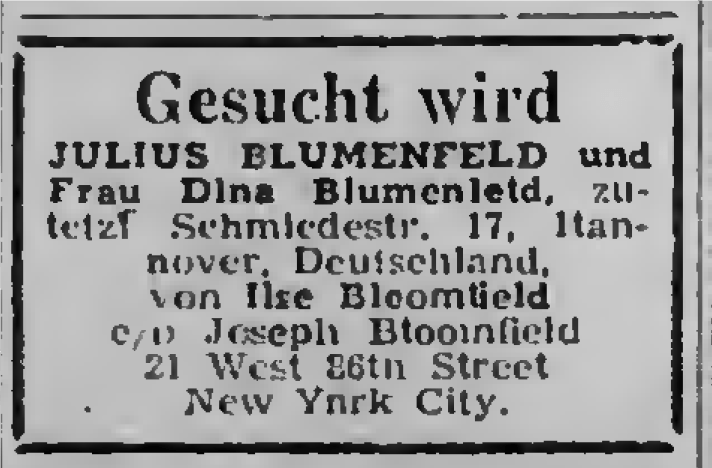
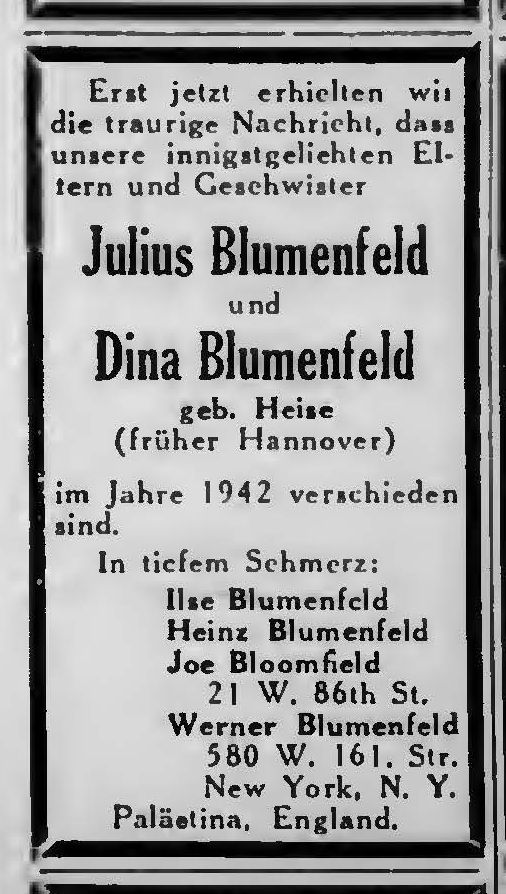
In September 1945, the family placed an obituary in the German immigrant newspaper Aufbau. Only 68 of the Jews from Hannover who were deported to Riga survived.
- Standesamt Neustadt (Hessen), Geburtsnebenregister 1885 (HStAMR Best. 915 Nr. 6468, Seite 16, Nr. 16. ↩︎
- Letter from Julius Blumenfeld to his brothers, 1. July 1, 1903, copie of the letter in author’s archiv. ↩︎
- Heiratsregister Hoof 1912, Blatt 13, in: Standesamt Hoof Heiratsnebenregister 1912, Hessisches Staatsarchiv Marburg (HStAMR Best. 909 Nr. 5251). ↩︎
- Meldekarte der Familie Blumenfeld-Heiser, Information from Edel Sheridan-Quantz, Landeshauptstadt Hannover, Zentrale Angelegenheiten Kultur (41.03), ZeitZentrum Zivilcourage, in email, vom März 21, 2022 to the author. ↩︎
- U.S. Public Records Index, 1950-1993, Volume 2, in: Ancestry.com. ↩︎
- GenWiki, Kategorie: Adressbuch für Hannover, http://genwiki.genealogy.net/Kategorie:Adressbuch_f%C3%BCr_Hannover. ↩︎
- Adressbuch, Stadt- und Geschäfts-Handbuch von Hannover, Hannover 1921, S. III/292. ↩︎
- U.S., Social Security Death Index, 1935-2014, Number: 065-24-7357; Issue State: New York; Issue Date: Before 1951, in: Ancextry.com. ↩︎
- According to Steven Bloomfield, New York, based on conversations with Ilse Blumenfeld Stein. ↩︎
- Adressbuch der Stadt Hannover zugleich Adressbuch von Hannover, Stadt- und Geschäftshandbuch, Hannover 1931, S. II/177 und S. III/26. ↩︎
- Adressbuch der Stadt Hannover zugleich Adressbuch von Hannover, Stadt- und Geschäftshandbuch, Hannover 1933, S. II/86. ↩︎
- Adressbuch der Stadt Hannover für das Jahr 1938, Hannover 1938, S. II/89. ↩︎
- Adressbuch der Stadt Hannover für das Jahr 1938, Hannover 1938, S. II/84. ↩︎
- Adressbuch der Stadt Hannover für das Jahr 1939, Hannover 1939, S. II/236. ↩︎
- Email from Steven Bloomfield to the author, August 12, 2017, 23:57h. ↩︎
- Email from Steven Bloomfield to the author, August 12, 2017, 23:57h. ↩︎
- Kentucky, Death Records, 1852-1964, in: Ancestry.com. ↩︎
- Jüdische Opfer der 2. Weltkrieg, Gemeinde Valkenburg-Houthem, in: Blik op de wereld, Joodse slachtoffers 2e WO gemeente Valkenburg-Houthem. ↩︎
- Deutschland Bundesarchiv Koblenz, Gedenkbuch – Opfer der Verfolgung der Juden unter der nationalsozialistischen Gewaltherrschaft in Deutschland 1933-1945. ↩︎
- Email from Steven Bloomfield to the author, August 12, 2017. ↩︎
- Schulze, Peter, Die Deportation aus Hannover am 15. Dezember 1941, in: Buch der Erinnerung. Die ins Baltikum deportierten deutschen, österreichischen und tschechoslowakischen Juden, Wolfgang Scheffler / Diana Schulle, 2 Bde., München 2003, Bd. 2, S. 765-768, hier S. 766. ↩︎
- Ibid. ↩︎
- Ibid. ↩︎
- In 1934, the synagogue had been renovated and converted into a gymnasium for Jewish organisations. After the destruction of the new synagogue in November 1938, the hall was once again used for religious services. (Klaus Mlynek / Waldemar R. Röhrbein, Stadtlexikon Hannover. Klaus Mlynek / Waldemar R. Röhrbein, Stadtlexikon Hannover. Von den Anfängen bis in die Gegenwart, Hannover 2009, p. 614). ↩︎
- Schulze, Deportation aus Hannover, S. 768. ↩︎
- Ibid. ↩︎
- Email from Steven Bloomfield to the author, August 2917. ↩︎
 Blumenfeld Family Stories
I tried to comment, but it didn’t go through.
Another branch of our Blumenfeld tree that was destroyed by the Nazis. Thanks for writing this.
LikeLike
Pingback: Ilse Blumenfeld and Moritz Stein | Blumenfeld Family Stories
Pingback: Heinz Blumenfeld and Sara Ita Wulfsohn | Blumenfeld Family Stories
Pingback: Joseph Blumenfeld / Joe Bloomfield and Claudyne Braun and Myrtle Strauss | Blumenfeld Family Stories