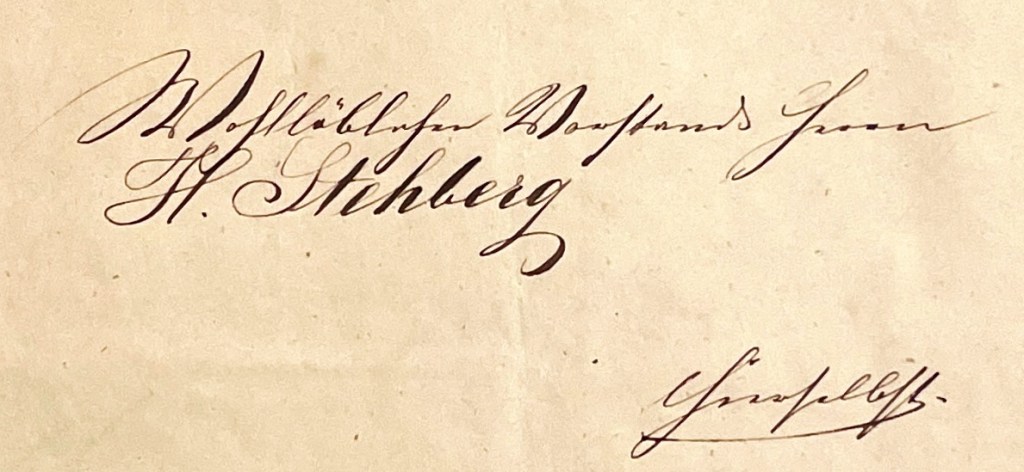
Among the Adelebsen Jewish Community records to be found in the YIVO Institute for Jewish Research Repository in New York is a collection of 18 letters and one postcard written by Sally Blumenfeld.1 They are written in Kurrentschrift (cursive script), an old form of German-language handwriting that was used well into the 20th century, combined with “Latin cursive.” Kurrent is a challenge for the modern reader, and there are not many people who are able to read it today. An additional challenge is that German vocabulary and spelling have undergone considerable changes since the middle of the 19th century when the teacher Sally Blumenfeld himself went to school. The text below is the first paragraph of the first letter in the collection, and provides a good example of this style of writing.
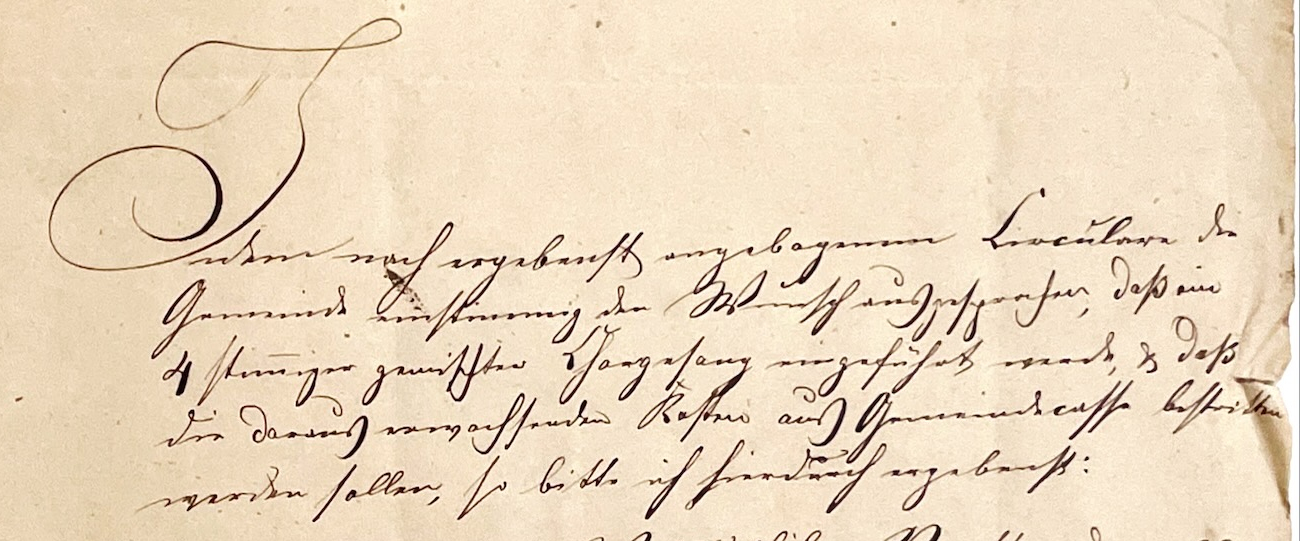
The German text of the above reads: Indem nach ergebenst angebogenem Circulare die Gemeinde einstimmig den Wunsch ausgesprochen, dass ein 4-stimmiger gemischter Chorgesang eingeführt werde, und dass die daraus erwachsenden Kosten aus Gemeindecasse bestritten werden sollten, so bitte ich hierdurch ergebenst:
The first two letters pertain to the establishment of a four-part mixed choir to accompany the worship services. Included is a set of requirements for the singers, as well as the duties of and membership in a committee to oversee the work of the choir. The letters are addressed to the textile merchant Herz Stehberg (1813-1886), who was head of the congregation from 1862 to 1868.2
In Sally’s first letter to the “honorable Board” (Wohllöblicher Vorstand!),3 he “most humbly requests” (ergebenst bitten) the executive of the community to form a commission of four persons to corordinate the choir’s affairs and to “assure that the members remain quiet and orderly during the worship service” (für Ruhe und Ordnugn des Chors während des Gottesdienstes Sorge zu tragen).
Sally requests in his second letter4 to the Wöhllöblichen Vorstand that the Board approve the attached rules and regulations for the choir. The rules leave nothing to chance:
- Every participant in the choir is obligated to attend choir practice regularly at the appointed time. A member of the commission must be notified when attendance is not possible.
- Be present in the synagogue at the start of worship, at the latest when the choir begins singing, on each Sabbath and on Holidays, as well as on the preceeding evening.
- Each participant will be assigned a seat by the head of the synagogue, at which place he must remain, not taking another place. Each member is required to take his seat upon entering the synagogue very quietly, and must remain seated there quietly and decorously during the service. Should someone have to leave the synagogue, this person must return to his assigned seat at the resumption of the service.
- When it is inoportune [mensturation] for the ladies who take part in the choir to participate in the same favorable way, the above provisions only apply to them to the extent that they must take part in the set practice hours in any case, and sing with the choir to the extent that it is possible for them.
- The teacher is responsible for the proper attendance and behavor of the participating school children, and any improper behavior is to be reported to the teacher by the commission.
The duties of the commission are also outlined in the rules and regulations:
- To arrange for the practicing of the music that they have chosen and to provice the necessary materials thereto.
- The commission alone determines the music to be sung.
- The commission is responsible for maintaining quiet and order during choir practice and during worhip and the choir members are obligated to strictly follow the directions of the commission.
- Those not following the above rules shall be reported to the executive board of the synagogue.
Should the commission find a person unworthy of participating int he choir, it is authorized to remove him, whereupon he must leave his assigned seat.
Indeed, Zucht und Ordnung — discipline — was the order of the day!
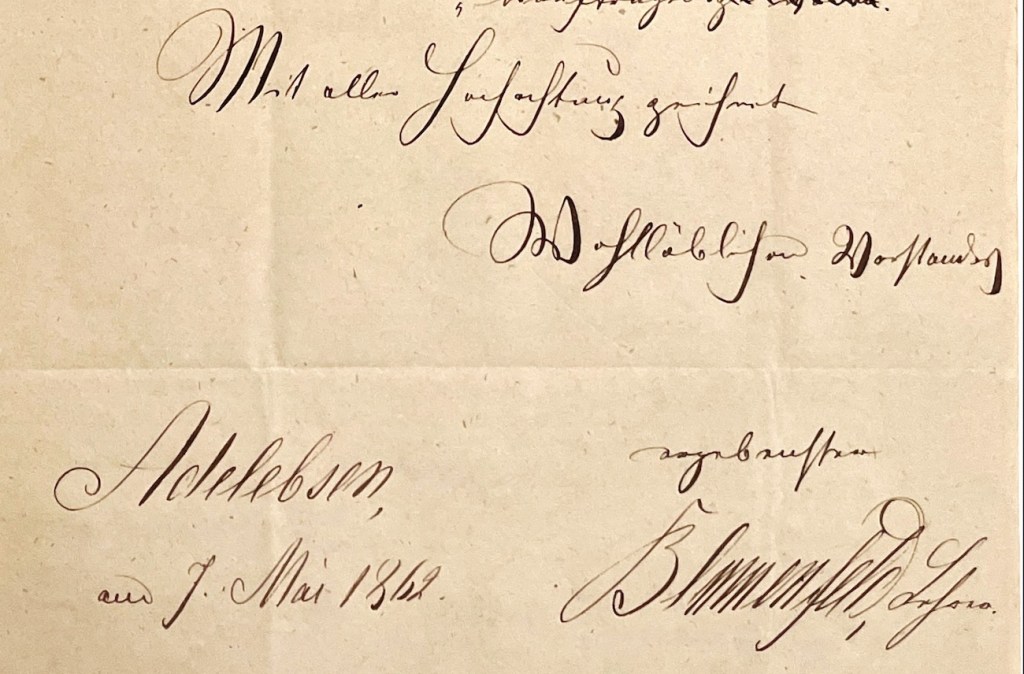
- YIVO Institute for Jewish Research, Adelebsen Jewish Community Records (RG244), Series IV, Subseries 2: Correspondence from community members and others, 1862-1913, Correspondence – Blumenfeld S., Jewish teacher, Box 4, Folders 90, 91 and 92. ↩︎
- Collection overview, Adelebsen Jewish Community Records, https://archives.cjh.org/repositories/7/resources/3594 ↩︎
- 14 April 1862. ↩︎
- 7 May 1862. ↩︎
 Blumenfeld Family Stories
Can you read that Kurrent script or did you need to find someone to help? I have had to find others to read it for me when needed.
I chuckled at the content for two reasons. One—it is just so German in character, all those rules and standards. That may be a stereotype of the German national character, but all stereotypes have some truth to them. Two—it’s just so typical of synagogue politics to have people hashing out things like this.
Thanks for sharing!
LikeLike
I’m quite good at reading Kurrent. It takes a few lines to get the hang of each person’s individual style, but then I find it not too difficult. I’m more often stumped by some long-forgotten term.
I think German-speaking groups in general try to have rules for every imaginable thing that in any way possible, one every hundred years could happen. You can imagine what board meetings are like here!! It is diffucult to translate this stuff in a way the reflects the convoluted and detailed style. And I chuckle over the subservient manner in which Sally addresses his board members.
There’s more to come.
LikeLiked by 1 person
Good for me to know the next time I need help reading Kurrent!
LikeLike