Scholum “Sally” Blumenfeld, son of the cattle merchant Jacob Blumenfeld and Frommet, née Isenberg, was born in Momberg in Hesse on 5 April 1842.1

The then 18-year-old Sally applied for the position of cantor, teacher and Shochet in Adelebsen based on this job offer that appeared in the Allgemeine Zeitung des Judenthums several times during the first half of 1860.2
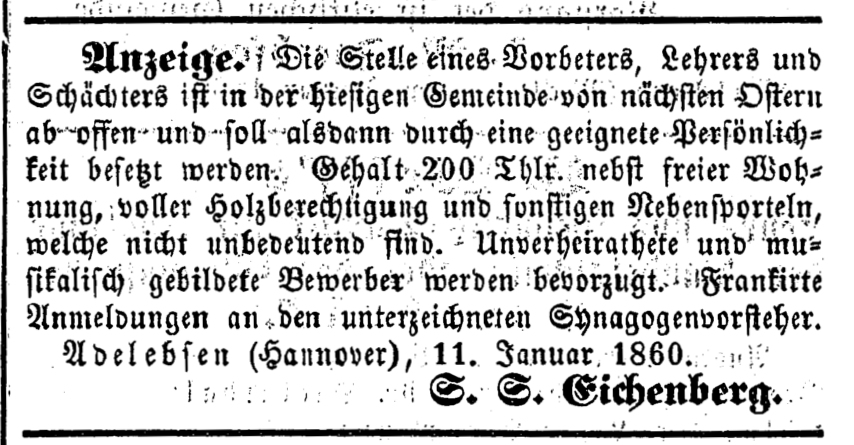
Job offer. The position of cantor, teacher and slaughterer in our community will become vacant next Easter and needs to be filled by a suitable person. Salary 200 Thalers, together with free lodging, heating, and other, not insignificant benefits. Single and persons with musical training are preferred. Applications can be sent to the undersigned president of the synagogue. Adelebsen (Hanover), 11 January 1860 S. S. Eichenberg
“The Jewish community in Adelebsen had its beginnings in the late 17th century. The first documentation of Jewish residents is a listing for a peddler and farmer by the name of Hertz Naphthali, and his wife and children, in a tax list of 1675. In 1696 there were two Jewish families in the town; and in 1796, 20 families. Through the early 19th century, Jews needed permission to settle in the town (as was the case elsewhere in Germany), in the form of a writ of protection (Schutzbrief), which specified their occupation, and Jews who did not have such permission were periodically expelled. Jews were granted full civil rights for a time under Napoleonic rule (1807-1813), and then, finally, in the kingdom of Hanover, in 1842.
“The number of Jews in Adelebsen steadily increased through the mid 19th century. In 1848, there were 149 Jewish residents, making up 13% of the town’s population. The Jews of Adelebsen mostly earned their living as peddlers, merchants, or proprietors of small businesses, including cattle and horse dealing; linen and cotton weaving; and lottery collection.
“The community built a schoolhouse in 1836, which also contained the living quarters of the Jewish teacher. It was located at 15 Lange Strasse (‘Long street’), the street on which most Jewish residents lived. As was typical, the office of teacher was combined with that of cantor (Vorsänger) and kosher butcher (Schächter).
“Baruch Schlesinger, of Goslar, was a teacher for several years in the mid 1850s. Sally Blumenfeld, of Momberg, Hesse, took up the teacher’s post in 1861, and remained for nearly fifty years, until 1910. Due to the dwindling number of students, the school closed in 1915.”
“In the late 1830s, the community erected a new synagogue, which was located in the vicinity of the schoolhouse. A communal mikveh, for ritual baths, was built around 1860.”“In the late 19th century there was a marked decline in the size of the Jewish community, with the nearby city of Göttingen being a destination for some. There were only 69 Jewish residents in Adelebsen in 1895; 51 in 1911; and 46 in 1925.”3
Indeed, the position of teacher, cantor and Shochet in Adelebsen which Sally began on 1 February 1861, was his first and only paid position.4
In Adelebsen Sally married Berta Freudenstein sometime before the birth of their first child in 1866. His bride was the daughter of Samuel Meyer Freudenstein from Adelebsen, and Caroline Traube from Peine near Hanover.5 Sally and Berta had five children: Lina (1866 – 1943), Hedwig (1868 – 1902), Karl (1869 – 1940), Johanna (1871 – 1944), and Hugo (1873 – 1942).
Sally Blumenfeld appears to have been a good and well-liked teacher. An article in the Israelitische Wochenschrift für die religiösen und sozialen Interessen des Judenthums about the 25th anniversary of Sally’s work in Adelebsen illustrates the way his students and the community thought about him:6
“February 1st marked 25 years of [Sally] Blumenfeld’s work as teacher in the local Jewish community. The celebration organized by the congregation and former students was a truly uplifting experience and bore witness to the blessed effectiveness of the jubilarian, who has been able to earn the love and affection of his community and his students in a manner rarely seen. In the morning, delegations from the community, and current and former students, as well as many friends and admirers of the jubilarian, some of whom had come from far away, congratulated him and presented him with beautiful and precious gifts.” “The jubilarian expressed his gratitude with few, however meaningful, words, emphasizing that he saw the celebration as a recognition of his good will, but that the honor belonged to God alone, who supports him with His Spirit.”
During the summer of 1894, the editor of the antisemitic newspaper Deutsches Wochenblatt, Mr. Georg from Nordhausen, held a rally in Adelebsen. Sally Blumenfeld was in attendance. His response to the speaker gives insight into his mindset and rhetorical ability, and was reported by the Freies Blatt, Organ zur Abwehr des Antisemitismus:7
“(Totally rebuked) The former postal assistant and current editor Georg from Nordhausen had convened an anti-Semitic meeting in Adelebsen. After his speech, which had the well-known content, the Jewish teacher Blumenfeld from Adelelbsen spoke up. First, in short, sharp words, he pointed out that anti-Semitism is just as inhuman as it is unchristian and has nothing to do with true Germanness [Deutschtum], and then he continued: “Call yourself anti-rogue, anti-scoundrel, anti-swindler, anti-usurer, etc. — and I will join you immediately and fight with you to my last breath with all my strength, until the last rogue and scoundrel is eliminated from our beloved German fatherland. Let us fight for truth and justice and follow the commandment of Christ, which was first a commandment of Judaism, “love one another” at all times. When we do that, then we are men who increase Germany’s greatness and prosperity, and only then can we say: Deutschland, Deutschland über Alles. At the end of his speech, the assembly rewarded these remarks with three cheers. The anti-Semitic speaker tried to refute these statements, but his replies made no impression.“
Sally Blumenfeld was unable to attend the meeting of the Teachers’ Association in May 1902 due to the serious illness of his daughter Hedwig.8 Hedwig Blumenfeld died in Adelebsen on 31 July 1902 at the age of 34. The picture of the gravestone and its translation are from Im Steilhang. Der Jüdische Friedhof zu Adelebsen by Berndt Schaller und Eike Dietert. (n.kl.Z. = the number for the millennium – in this case “5” – has been left off.)9
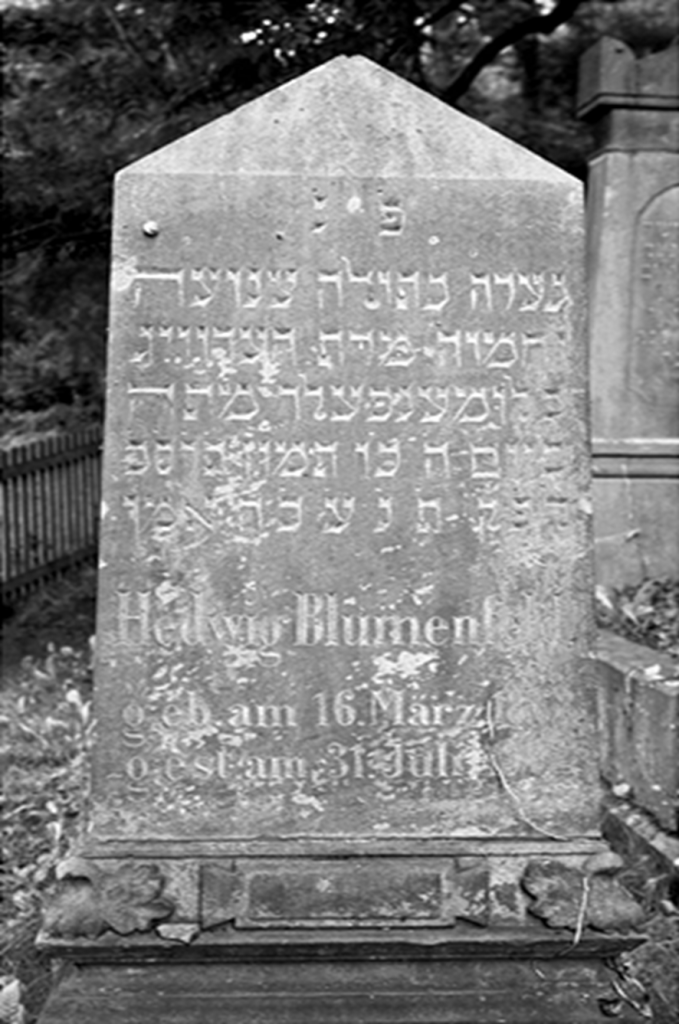
Here rests
an unmarried worman, humble and lovely,
Hedwig Blumenfeld, she died
on day 5, 26 Tammuz 662
n.kl.Z. May her soul be bound up in the bundle of life.
Amen.
Hedwig Blumenfeld
born 16 March 1868
died 31 July 1902
Back side: Love unites the living with the dead.
While visiting Germany in 1903, Sally’s brother Gerson Blumenfeld / George Bloom- field, who had emigrated to Kentucky, USA, in the 19th century, wrote home about his reunion with Sally:
“Life is fine here. We have meat every day for every meal. On Shabbos I went to temple three times. You know, I liked that. Sally is not so religious. He doesn’t care if I smoke on Saturday. […] He has a fine family.”10
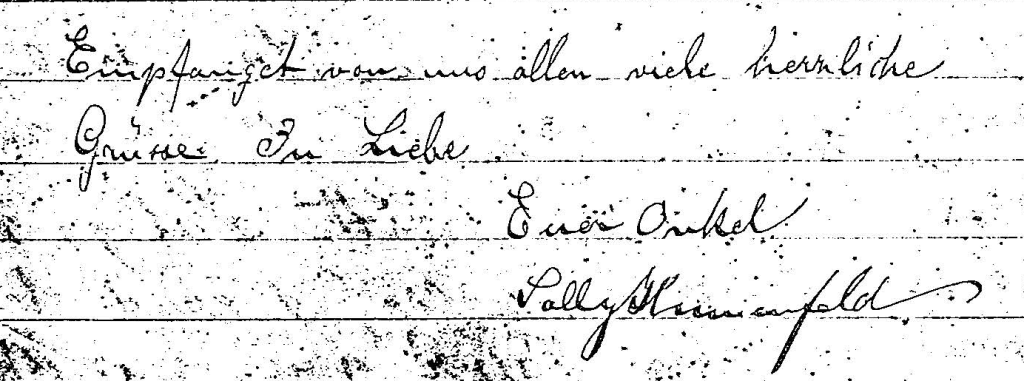
After almost 50 years of service to his community and his profession, Sally Blumenfeld retired at the end of September 1910. The following announcement was printed in the Israelitisches Familienblatt on 7 October 1910:

Announcement
On October 1st, our colleague Blumenfeld, Adelebsen, retired after almost 50 years of teaching. With the modesty that is always characteristic of him, he waved off every compliment, the colleague who deserves so much credit for the teaching profession, who for decades was the chairman of the Hanover Provincial Association, the co-founder of the Teachers’ Union, was its second chairman for two election periods, and was also its chairman for a short time. The elder colleague is thinking of moving to Göttingen after the holidays; may he be granted a cheerful, happy retirement!
At a teachers’ meeting after his retirement Sally received a special gift according to this note in the minutes: “He was particularly pleased by the significant financial donation from the Hanover teachers, which was given to him as the ‘Blumenfeld Foundation.’ He ensured the givers that he will see to it that the amount will grow and work to benefit the association and its members.”11
Gladys and David Blank12 write that Sally moved to Göttingen after his wife’s death. However, the fact that the obituary and thank-you cards have an address in Göttingen, and that Sally was already talking about moving to Göttingen before his retirement in 1910, leads to the conclusion that he and his wife had moved there before her death.
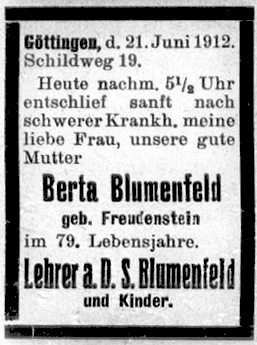
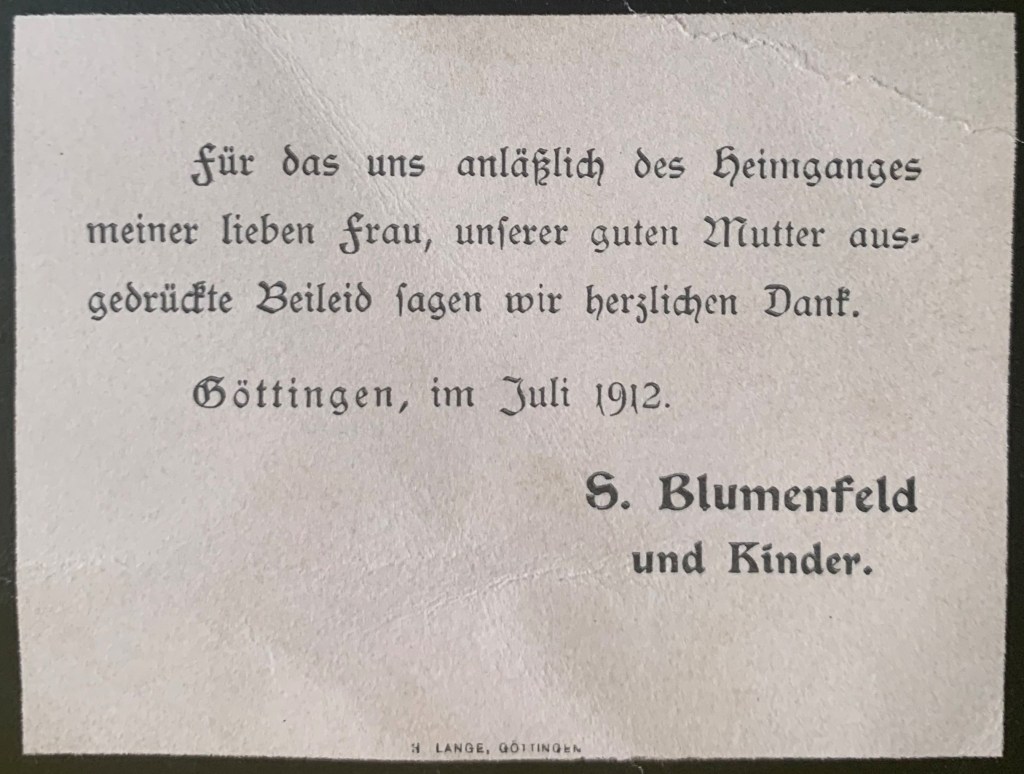
Berta Freudenstein Blumenfeld died in the late afternoon of June 21st, 1912, “as a result of a serious illness.” Her obituary appeared in the Israelitisches Familienblatt on 27 June 1912, page 16. Next to the obituary is the card which Sally’s brother Gerson/George received, thanking him for his expressions of sympathy. Her grave is in the Jewish Cemetery in Adelebsen.13
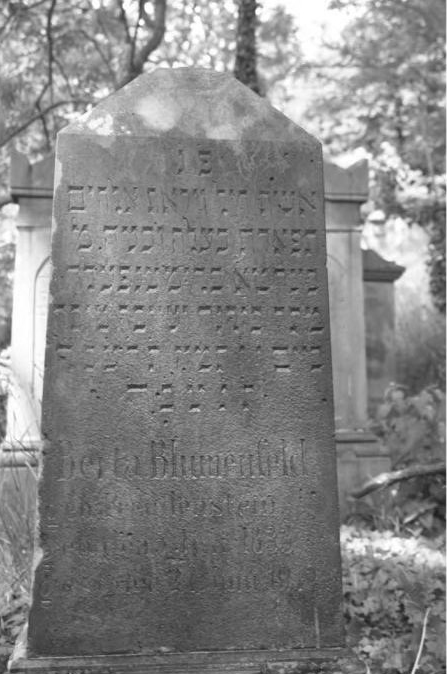
Here rests
a women of noble charcter and God fearing,
an adornment to her husband and her children,
Berta Blumenfeld
She died at a good, old age
on day 6, 6 Tammuz 672 n.kl.Z.
Ma her soul be gathered up
in the bundle of the living.
Berta Blumenfeld
née Freudenstein
born 5 July 1833
died 21 June 1912
Back side: Death cannot separate what love has joined.
In honor of Sally Blumenfeld’s 80th birthday, his colleague Sally Katz from Nienburg/Weser wrote an article praising Sally’s professional achievements:14
“[…] It is not my aim here to describe Blumenfeld’s life apart from his achievements in education. I don’t want to talk about Blumenfeld’s work and achievements in the community to which he devoted his entire energy from the beginning to the end of his teaching career, the community of Adelebsen, in which he worked for more than half a century as a teacher and preacher, for whose in habitants he was friend and adviser, for whose widows and orphans he was guide and father in the most beautiful sense of the word [1861-1910]. The recognition of these aspects of his life must be done by a more qualified person. – Our good wishes go to the honorary chairman of the Association, the man who has headed the Association of Jewish Teachers in the Province of Hanover for more than three decades, who was a member of the board of directors already in 1883, and was the Association’s first chairman from 1888 to 1908.
What Blumenfeld has achieved in the Association and done for it cannot be described here. How could a newspaper article describe such a richly blessed activity, how could one sketch in a few strokes a picture that can only be felt and experienced! Blumenfeld’s work is inextricable linked to the history of the Association. The Association meetings that Blumenfeld chaired and that he enriched with his spirit will remain unforgettable for every participant. When Blumenfeld opened the conference in his innate calm and dignified demeanor, glowing with a mild fire of enthusiasm, everyone felt: this is a leader speaking. Everyone felt drawn to him, everyone submitted to him willingly, because everyone knew that Blumenfeld’s gaze was always focused on the goal, on the truth, that everything he said was in harmony with his innermost convictions, and everyone was aware that he was pointing the way that would move everything, albeit slowly, surely toward the goal.
Blumenfeld also became the father of the Union of Jewish Teachers’ Associations in the German Reich [Co-founder, Vice-chairman (1895) and Chairman (1901)]. He was the “Sower of that seed, which over the years developed into a powerful tree, whose roots today extend throughout all of Germany, from the extreme north to the far south”. And wat the Union achieved, especially in the early years of its existence, whether it be rated high or low, is closely linked to the name of its first chairman. This position was the symbol of the esteem that Blumenfeld found in the eyes of his fellow teachers throughout the German Empire; he was and is still regarded as the ideal of a teacher in Israel, as the adornment and crown of the teaching profession in general.
Last but not least, we express our appreciation to our loyal friend. Those who were privileged to get closer to Blumenfeld, those who were fortunate enough to visit his house, to listen to intimate conversations of deep erudition, which is coupled with rich life experience, to feel the penetrating sharpness of intellect, which, combined with the intimacy of the childlike mind, will count the hours he was allowed to spend in Blumenfeld’s home among the most beautiful and unforgettable of his life.”
In addition to this impressive list of accomplishments, Sally Blumenfeld was also chairman of the Burial Society and the Jewish Readers’ Society in Adelebsen. Sally was also an honorary member of the Jewish Community of Adelebsen.15
Scholum/Sally Blumenfeld died in Göttingen on 14 November 1925 “in the 84th year of his fruitful [lit. rich on blessing] life”.16
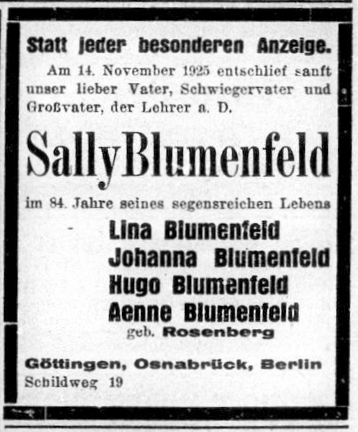
Instead of cards
Our dear father, father-in-law and grandfather, former teacher passed away peacefully on 14 November 1925.
Sally Blumenfeld
In the 84th year of his life rich in blessings.
Lina Blumenfeld
Johanna Blumenfeld
Hugo Blumenfeld
Aenne Blumenfeld, née Rosenberg
Göttingen, Osnabrück, Berlin
Schildweg 19
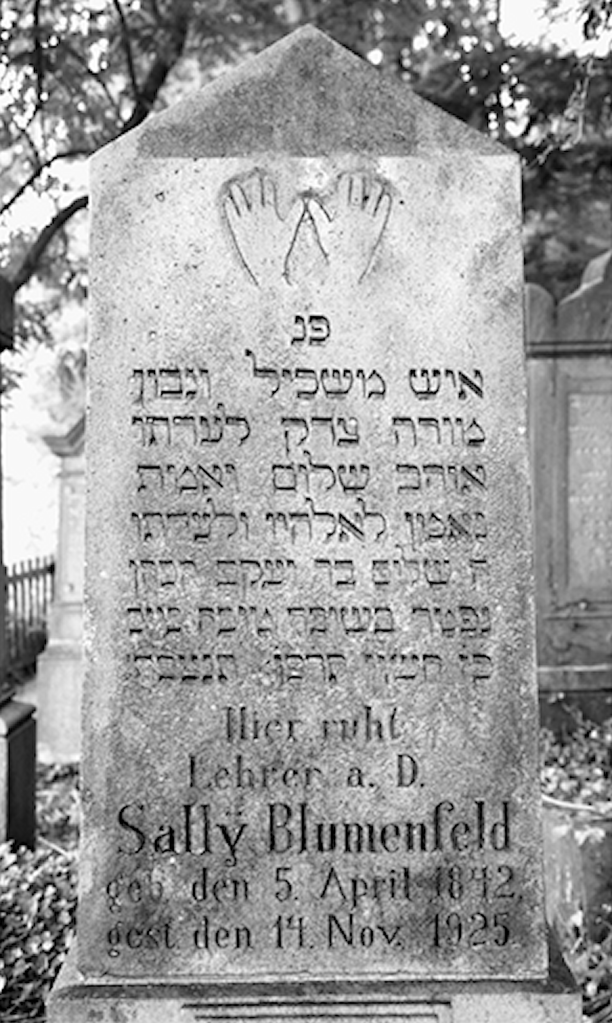
The inscription on the headstone echoes the words of Sally Blumenfeld’s colleague Sally Katz from 1922:
Here rests
a judicious and reasonable man,
a righteous teacher for his community.
He loved peace and truthfulness,
was faithful to God and his community,
Shalum, son of Jaakov ha-Kohen.
He died in a good, old age on
27 Cheschwan 686:
May his sould be gathered up in the bundle of life.
Back side: Love is stronger than death.
- Geburtsregister der Juden von Neustadt 1824-1884, HHStAW Abt. 365, Nr. 628. ↩︎
- Allgemeine Zeitung des Judenthums, Leipzig, 31 January, p. 75, 7 February, p. 90, and 8 May, p. 286, 1860. ↩︎
- Center for Jewish History, “Adelebsen, Historical Note.” ↩︎
- Allgemeine Zeitung des Judenthums, Leipzig, 16 February 1886, p. 124. ↩︎
- I can find no primary sources for Berta Freudenstein and her parents. The information is taken from Glady and David Blank’s website blankgenealogy.com. ↩︎
- Israelitische Wochenschrift für die religiösen und sozialen Interessen des Judenthums, 2 February 1886, p. 53. ↩︎
- Freies Blatt, Organ zur Abwehr des Antisemitismus, p. 7, 22 July 1894, Vienna. ↩︎
- Israelitisches Familienblatt, p. 10, 31 July 1902. ↩︎
- Schaller, B., & Dietert, E. (2010), Im Steilhang, https://doi.org/10.17875/gup2010-470, License: https://creativecommons.org/licenses/by-nd/3.0/de/. ↩︎
- George Bloomfield to his family from Adelebsen on 3 June 1903. ↩︎
- Israelitisches Familienblatt, 25 May 1911, p. 9. ↩︎
- Glady and David Blank’s Genealogy, blankgenealogy.com. ↩︎
- The picture of the gravestone and its translation is from Im Steilhang. Der Jüdische Friedhof zu Adelebsen by Berndt Schaller und Eike Dietert. ↩︎
- Israelitisches Familienblatt, 30 March 1922, p. 9. ↩︎
- blankgenealogy.com. ↩︎
- [1] Obituary from Israelitisches Familienblatt, 19 November 1925, p. 5, gravestone from Im Steilhang. Der Jüdische Friedhof zu Adelebsen by Berndt Schaller und Eike Dietert. ↩︎
 Blumenfeld Family Stories
Pingback: Lina Blumenfeld | Blumenfeld Family Stories
You sure had some strong Jewish roots! And you are making my job so much easier….great research, meaning I will not have to duplicate your efforts if/when I get to Jacob’s line.
LikeLike
Pingback: Karl Blumenfeld: Victim of the “Aktion T4” | Blumenfeld Family Stories
Pingback: Johanna Blumenfeld (1871 – 1943) | Blumenfeld Family Stories
Pingback: Hugo Blumenfeld and Anna Rosenberg | Blumenfeld Family Stories
Pingback: Sally Blumenfeld: Correspondence – The choir | Blumenfeld Family Stories
Pingback: Sally Blumenfeld: Correspondence – More room | Blumenfeld Family Stories
Pingback: Sally Blumenfeld: Correspondence – Waiting for an answer | Blumenfeld Family Stories