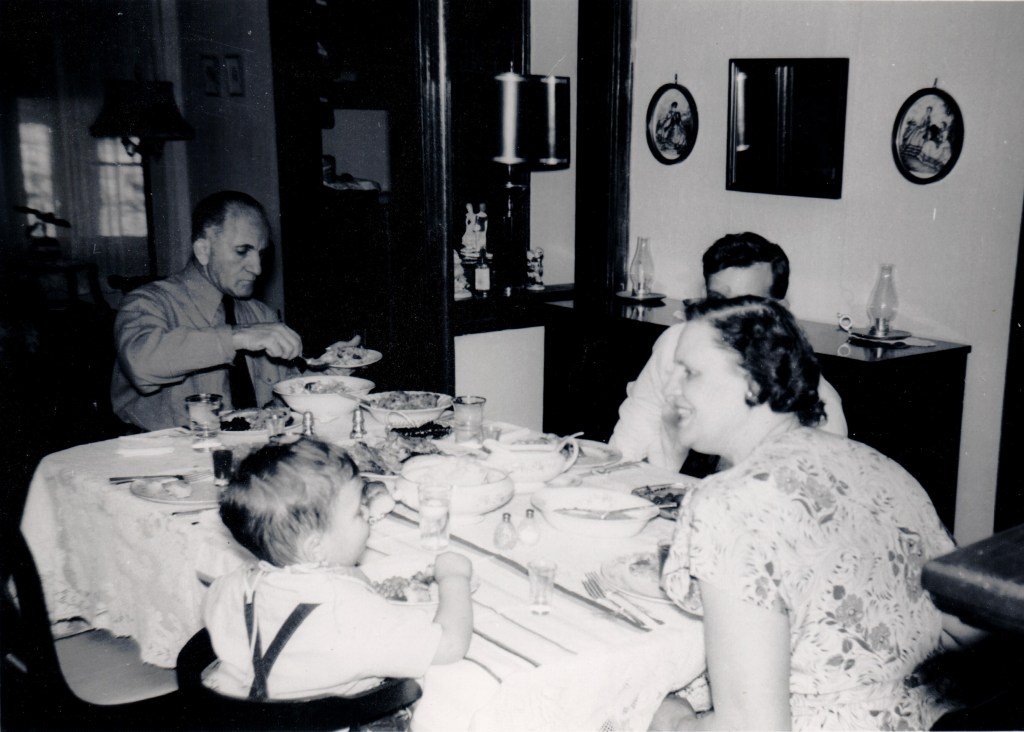
When this picture was taken, I was not yet old enough to know or be affected by the rules governing eating at Grandma’s. I did not yet have to wait for Grandpa to help himself to everything first. However, everyone else did. The full serving bowls are clustered around Grandpa’s place. While Dad and Grandma are busy with me and Mother is capturing the scene for posterity, Grandpa is oblivious to us all. He’s busy filling his plate. He insists on his “right” as head of the family to be served first.
Mother told me that once, when Grandpa didn’t get served first, he overturned the table. I believed her. Eating with Grandpa always meant: “Don’t provoke your Grandfather!” Thankfully, Grandma was a good cook and we always ate well. It compensated us for our efforts.
Grandpa really believed in the saying, “Children should be seen and not heard.” There were two German sentences, learned from his parents, that he used in this connection. The first one was, “Halt’s Maul! (Shut up!).” And the second ran in the same vein, “Kennst du meine Faust? (How would you like a punch in the face?).” Not that he ever hit any of us grandkids. But the message was clear. I think Grandma was glad that the dining room wasn’t big enough for all of the children and grandchildren. On holidays the grandchildren always ate at a safe distance from Grandpa in the kitchen of their house at 1900 Tatum.
 Blumenfeld Family Stories
Usually I think children are lucky to grow up near their grandparents. In your case—maybe not. How do you feel about it after all these years?
LikeLike
There are stories coming (already written and ready to be posten) that will give a look at the positive sides of “Life with the Bloomfields.” I wasn’t called “The Crown Prince” for nothing!
LikeLiked by 1 person
I look forward to those!
LikeLike