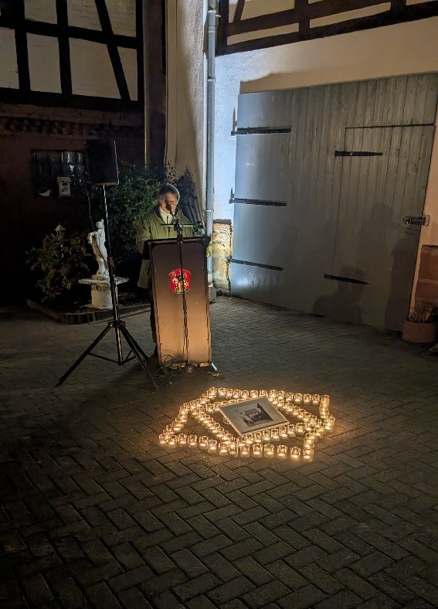
On November 8, earlier than elsewhere, the SA rampaged through Momberg—a sort of dress rehearsal, so to speak, for the terror and destruction that would unfold in Germany and Austria during Kristallnacht on November 9 and 10, 1938. For this reason, the “Neustadt erinnert” working group invited the public to a Kristallnacht commemoration on November 8, 2026, in the courtyard in front of the former Momberg synagogue.
Neustadt’s city archivist, Andrea Freisberg, and the owner of the old synagogue building, Marc Lecher, provided the nearly 100 attendees with historical context. The event was enriched by musical performances by Kerstin Richter-Broska, who sang the well-known song about the Holocaust, “Dona Dona,” as well as “Where Have All the Flowers Gone,” with great feeling and sensitivity.
Here is a slightly abridged version of the speech provided by City Archivist Andrea Freisberg on the history of the Jewish community in Momberg and the synagogue. My blog post about the synagogue can be found here. The blog post about Mayor Thomas Groll’s closing remarks can be read here. What building owner Marc Lecher said about the memories of Kristallnacht that are still alive in his family can be found here.
Dear Guests,
On behalf of the “Neustadt erinnert” working group, I would like to extend a warm welcome to you all. We have gathered here today to commemorate the Reichspogromnacht, which occurred 88 years ago. This is the first time a memorial event of this kind has been held here in Momberg.
Eighty-eight years ago, on the night of November 8–9, 1938, marauding SA members rampaged through the town. They attacked residents in Jewish homes and destroyed the interior of the synagogue. We have gathered today in front of this former house of worship to reflect on these events.
As in Neustadt and several other nearby towns, the riots in Momberg began a day earlier than those in the rest of the German Reich.
The attacks were carefully planned and carried out in a targeted manner. They served as a model for the subsequent outbreaks of violence, which culminated in what became known as “Kristallnacht.” Mr. Lecher, the owner of this building, will later recount what happened that night, drawing on the memories of his parents and grandparents.
A particularly important source regarding the events of that night are the memoirs of Ruth Spier, who was known in the village as “Tante Röschen.” A few years after the end of the war, she returned to her old home and lived in Momberg until her death.
But first, I’d like to take a look back at history with you: How did the small town of Momberg come to have its own synagogue? I’ll explore this question with a brief overview of the Jewish community’s history in Momberg.
It is unclear exactly when the first Jews arrived in Momberg or why they settled there. However, records indicate that there were at least 13 Jewish residents in 1747. Together with the Jewish residents of Neustadt, they established a synagogue and attended services there.
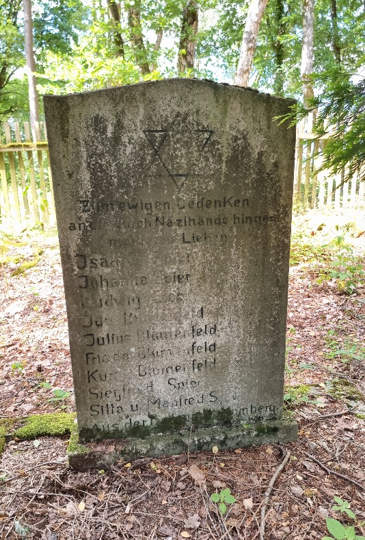
Until 1828, the community buried its dead in the cemetery in Hatzbach. Between 1828 and 1830, a new cemetery was established along the road between Momberg and Neustadt, which still exists today. There, on the Simmesberg—formerly known as Simonsberg—there are about 140 gravestones. A special memorial stone commemorates the Jewish residents of Momberg who were murdered during the Nazi era.
But back to the community’s development: By 1861, Momberg was home to 49 Jewish residents, accounting for 6.5% of the total population of 753. Several years earlier, the Jews of Momberg had applied for permission to hold religious services in their own town. By then, the required number of ten men of religious age had been reached. This requirement, along with proof of a synagogue of their own, ultimately made it possible for them to separate from the Neustadt congregation.
On the site now known as Burgasse 10—right here where we are standing—the Jews of Momberg erected a half-timbered house. They had purchased it as a barn in Ebsdorf and then rebuilt it in Momberg. After renovations, the building was ready to serve as a synagogue. On April 19, 1858, Blumenfeld, the elder of the Momberg congregation, informed the Marburg rabbinical office that the synagogue was prepared for religious services. The synagogue accommodated about 40 men and 22 women.
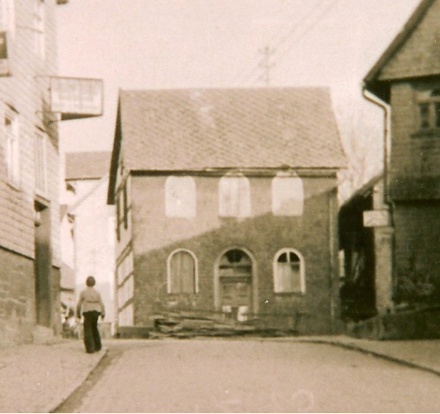
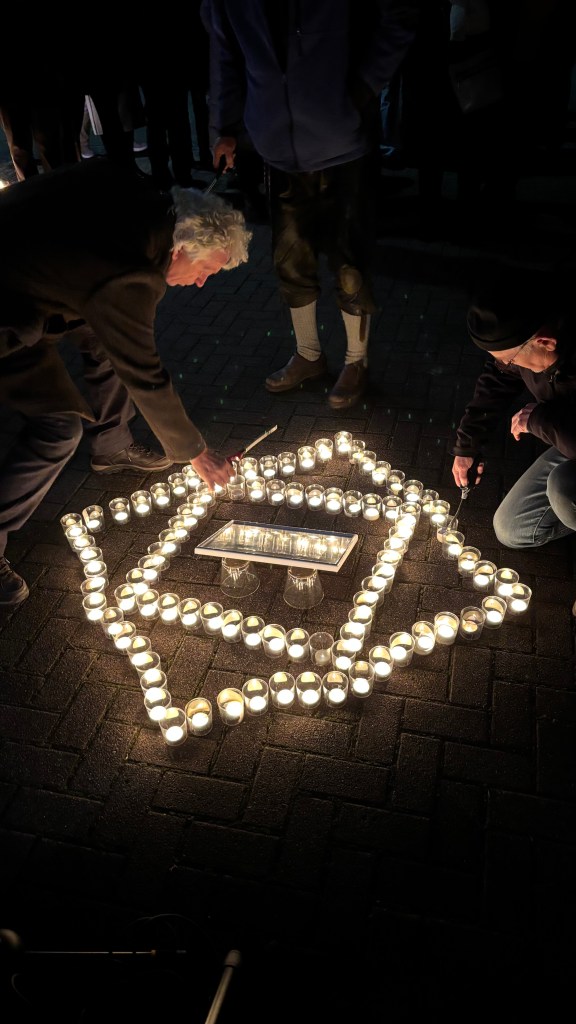
The building had a nearly square floor plan. The characteristic round-arched windows were located on the north and west sides. Their shapes are clearly visible in the current exterior wall cladding. At that time, the entrance was located on the western eaves side of the building and was clearly visible from the main street. Its exact location can still be determined today based on marks in the stone foundation. This layout is clearly visible in the photo we have placed in the center of the candles.
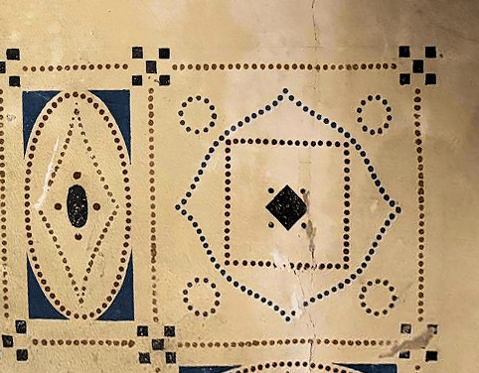
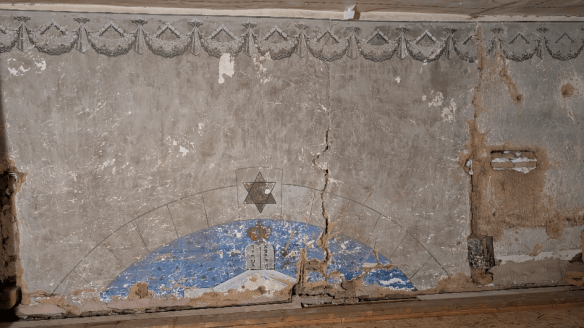
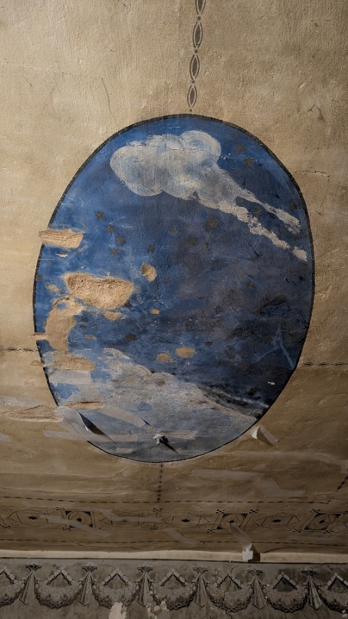
Many colorful murals adorned the synagogue. Part of the ceiling was designed to resemble a starry sky. Fortunately, despite the severe destruction during Kristallnacht, some remnants of these decorations have survived. They give a sense of how richly the synagogue was once adorned. Incidentally, the arrangement of our candles echoes one of these ceiling ornaments.
We expect to lay Stolpersteine in Momberg for the first time in 2028. The idea came up last summer. At that time, several descendants of the Blumenfeld family—now known as Bloomfield—visited Neustadt and Momberg. They were very interested in their grandparents’ and great-grandparents’ hometown, toured the former homes of their ancestors, and visited the graves of their relatives.
We have been in regular contact with one of the visitors, Richard Bloomfield, since then. He and other family members have already confirmed their participation in a Stolperstein ceremony and will be traveling from various countries to attend.