Hugo Blumenfeld, the youngest of the children of Sally Blumenfeld and Berta, née Freudenstein, was born at Adelebsen on 6 November 1973.1 His profession was Kaufmann (merchant, businessman).2 Hugo married Anna Rosenberg from Dortmund, born on 31 August 1889. Documentation for her comes from Sally Blumenfeld’s obituary: “Aenne Blumenfeld, geb. Rosenberg,” and entries in the Gedenkbuch in the German Federal Archives and at Yad Vashem.
Although there are numerous entries in the Berlin address books for “Hugo Blumenfeld”, the only certain documentation for Hugo and Anna’s address in Berlin comes from the holocaust records: 15 Duisburger Strasse. Hugo’s name is listed at this address first in the Berlin address book in 1935.
The Weiner website in MyHeritage lists two children born to Hugo and Anna: Hans and Hilde. However, the website provides no source for this information. The family tree COMPLETEKUNFAMILY9.25.2019 in Ancestry says that Hans was born in Berlin on 16 April 1915 and died in Johannesburg, Gauteng, South Africa on 25 October 1978, and that he was married to Ursel Charlotte Henschel, born in Breslau on 3 August 1922. This website mentions three unnamed children (“private”) born to Hans and Ursel. Again, there is no source given.
Hugo Blumenfeld and Anna Rosenberg Blumenfeld were deported from Berlin the Theresienstadt Ghetto with transport I/25 on 17 July 1942.3

“This transport departed from Anhalter Bahnhof in Berlin on 17 July 1942 and arrived in Theresienstadt in the early evening of the same day. The transport consisted of 100 Jews, of whom 75 were women and 25 were men. The average age of the deportees was 68.6. The youngest was a 41-year-old woman, and the oldest was 84 years old. Eight among them were between 46 and 60 and ninety-one between the ages of 61 and 85.
“The deportees were ordered to appear at the assembly camp in Grosse Hamburger Strasse or were taken from their homes by the Gestapo. A couple of Gestapo men, members of the Jewish desk, would usually show up, in order to round up the Jews destined for deportation. The Jews were requested to hand over the apartments in tidy form, after they had paid all taxes. The Gestapo men searched the deportees’ luggage, and the apartment, and often confiscated valuables. Subsequently they sealed the apartments. Jewish wardens who assisted the deportees in packing and carrying their belongings accompanied the Gestapo men. Trucks drove the Jews to the assembly site. This process usually took place one day prior to the actual deportation. At the assembly site the Jews were forced to sign a declaration, authorizing the transfer of their property to the state.
“As in previous transports, they were woken up on the day of deportation between two and three in the morning, received a simple breakfast prepared by the Jewish community and had to leave the building in Grosse Hamburger Strasse at approximately 04:00. They marched a few hundred meters to Monbijouplatz where a BVG streetcar (Berliner Verkehrsbetriebe – Berlin Transportation Company) awaited them. At around 05:00 they boarded the tram which transferred them expeditiously to Anhalter Bahnhof located on Schöneberger Strasse where they arrived by 05:15. There, through a side entrance, they were led to platform No. 1. They were ordered to board two old third-class rail cars, ordered from the Reichsbahn, which were connected to a regular, scheduled passenger train that left the train station every day at around 06:00 am for Dresden where it stopped for a few hours. On the first transports the deportees received a stew provided by the Dresden Jewish community. In Dresden the cars with the Jews were connected to another regular train headed for Prague.
“The train’s route took the deportees from Berlin to Dresden and along the river Elbe to Decin (Tetschen), Usti nad Labem (Aussig) and finally to Bohusovice (Bauschowitz). The deportees were taken off the train at Bohusovice station and forced by the awaiting SS personnel and Czech gendarmerie to walk the approximate 3 km to Theresienstadt, carrying their backpacks. Only people who were unable to walk were taken in trucks. The transport was given the reference I/25 in the Theresienstadt ghetto listings where the Roman numeral I refers to Berlin. In Theresienstadt many of the elderly Jewish deportees who had arrived on these transports died of hunger and disease during the summer months. Others were later transferred to extermination camps in the East where they were murdered.”
“According to historian Rita Meyhöfer, no deportee from this transport is known to have survived.
“This was the 25th of 123 transports organized from Berlin to Theresienstadt during the war that were made up mainly of elderly Jewish deportees (Alterstransporte).”4
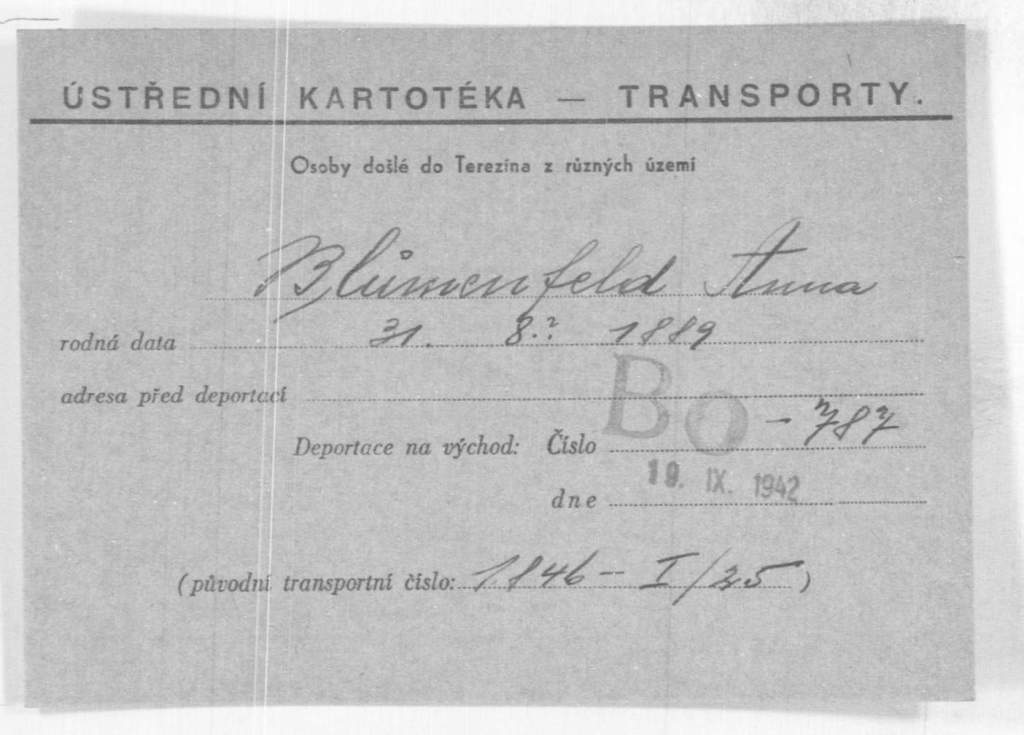
Although a file card from Theresienstadt (at left)5 has her listed as being transported to “The East” on 19 September 1942 with transport BO-787, the handwritten entry in the list above indicates that Anna Rosenberg Blumenfeld died on 9 August 1942 while still in the Ghetto at Theresienstadt. This handwritten entry into the ledger has not been taken into consideration by the Yad Vashem documentation nor by the people laying the Stolpersteine in Berlin.
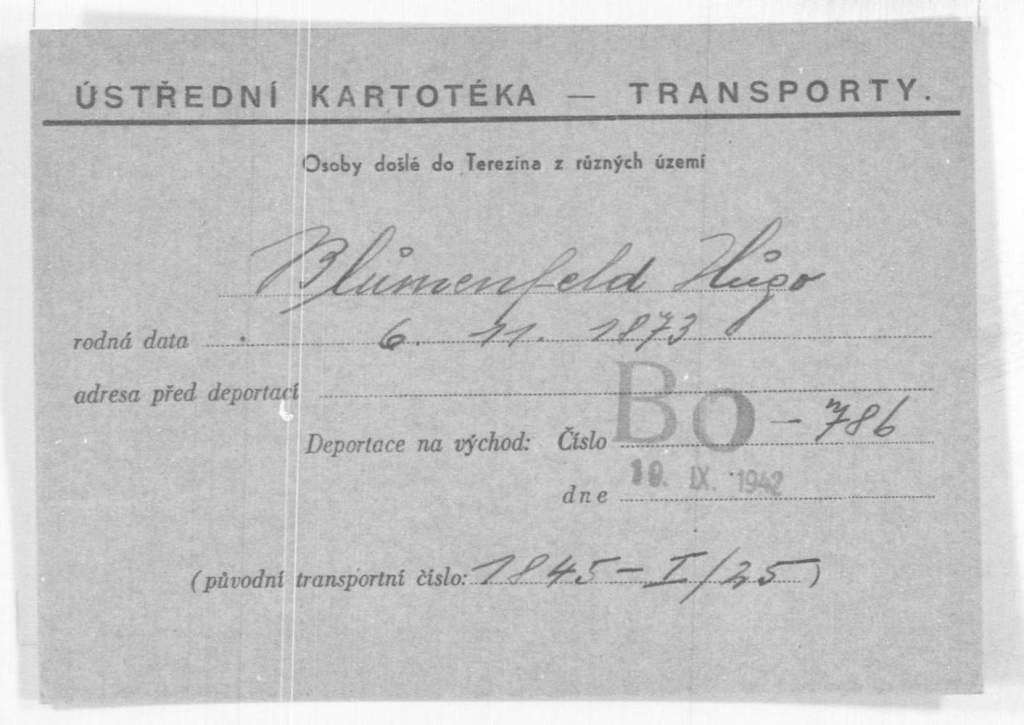
Hugo Blumenfeld was taken from the Theresienstadt Ghetto to the extermination camp at Treblinka, Poland, with about 2,000 others6 with the transport BO on 19 September 1942.7 Treblinka is not given at the transport’s destination. The words on the card “Deportace na východ“ mean “deportation to the east”. Hugo was murdered in Treblinka either before his arrival in the death camp or after his arrival on 21 September 1942.8
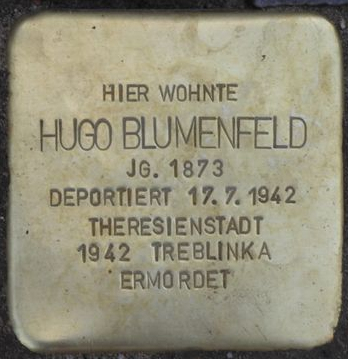
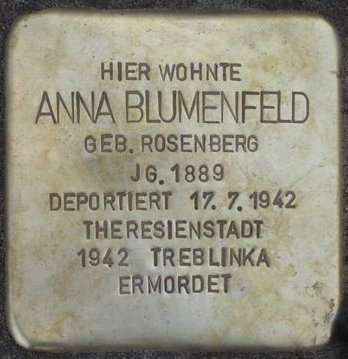
Stolpersteine for Anna and Hugo Blumenfeld were laid on 30 November 2021, in front of their last permanent residence in Berlin at 15 Duisburger Strasse.9
- Gedenkbuch, German Federal Archives, Arolsen Archives, various deportation lists. ↩︎
- Entries in the Berlin address books for 1935 to 1941. ↩︎
- https://documents.yadvashem.org/index.html?language=en&search=global&strSearch=3688090&GridItemId=3688090. ↩︎
- Transport I/25 from Berlin, Berlin (Berlin), City of Berlin, Germany to Theresienstadt, Ghetto, Czechoslovakia on 17/07/1942, https://deportation.yadvashem.org/index.html?language=en&itemId=5093000 ↩︎
- From the Arolsen Archives. ↩︎
- Liste aller Transporte aus Theresienstadt, in: katalog.terezinstudies.cz. ↩︎
- Arolsen Archives. ↩︎
- Yad Vashem, http://www.tenhumbergreinhard.de/05aaff9c310b0fe15/05aaff9c361172615/index.html. ↩︎
- Photos and date from: https://www.berlin.de/ba-charlottenburg-wilmersdorf/ueber-den-bezirk/geschichte/stolpersteine/denksteine/artikel.1223766.php. ↩︎
 Blumenfeld Family Stories