Johanna Blumenfeld, Sally and Berta Blumenfeld’s fourth child was born in Adelebsen on 6 December 1871.1 She worked for the department store L. Heymann in Osnabrück as a business manager (Prokuristin). The address books for Osnabrück show that she was living at 18/19 Markt in the center of the old town in the same building as the store L. Heymann. The store’s owners, Hermann Heymann and Gustav Hirtz also had apartments there. Upon her retirement in 1937, she moved to Göttingen and lived with her sister Lina at 6 Wöhlerstrasse.2

In 1929 Johanna and her sister Lina moved to Hanover and lived at 13 Wissmann Strasse in one of two houses owned by the Simon’sche Stiftung (a Jewish foundation). “These houses were the last voluntary places of residence of more than 60 victims of the Nazi era.”3[1]Stoplersteine for Lina and Johanna Blumenfeld were placed in front of 13 Wissmannstrasse in 2010.
Lina und Johanna were forced to move into a Judenhaus at 16a Wunstorfer Strasse.4 Shortly thereafter, the third and last large transport of older Jews from northwest Germany began. The website “Statistik des Holocaust” quotes the Gestapo’s plans for the deportation to Theresienstadt:
“The Jews to be deported from the City of Hanover are to be concentrated at the Horticultural School in Ahlem [located at 1 Wunstorfer Landstrasse] under the supervision of the Hanover State Police by 19 July 1942. The arrest and transfer of the Jews in die districts of Hanover affected by this order are to be carried out be the authorities of the district and the police. It is anticipated that the arrests will take place here on 20 July 1942.”5

Johanna was deported to the Ghetto at Theresienstadt on 23 July 1942 where she died at the hands of the Nazis on 3 March 1943. In November 1956 the registry entry below of Johanna’s death was made by the Sonderstandesamt Arolsen. The special registry office is a unique facility that only exists in Bad Arolsen. The task of the office is the certification of deaths in the former German concentration camps. The special registry office works closely with the Arolsen Archives, which is also based in Bad Arolsen.6
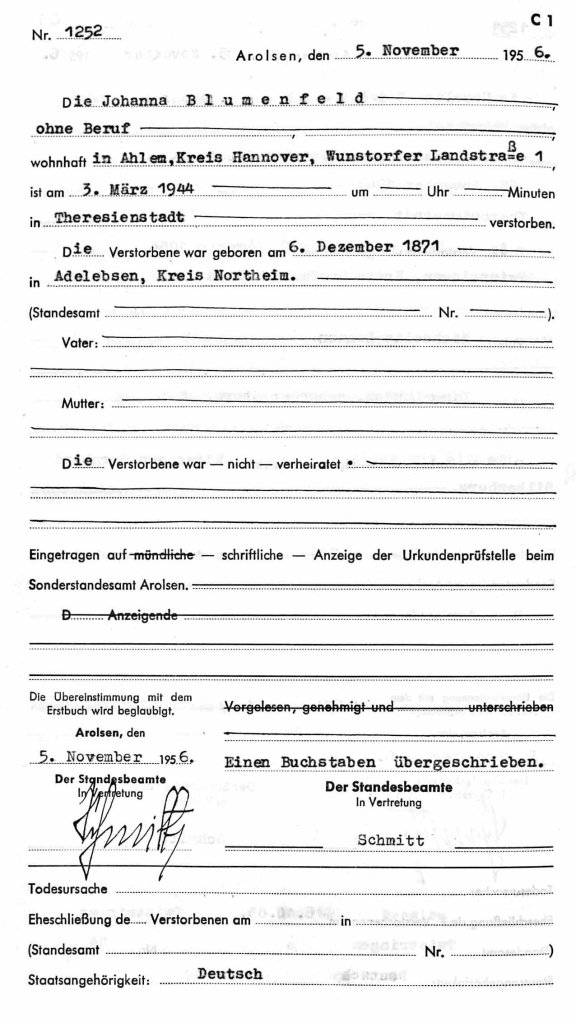
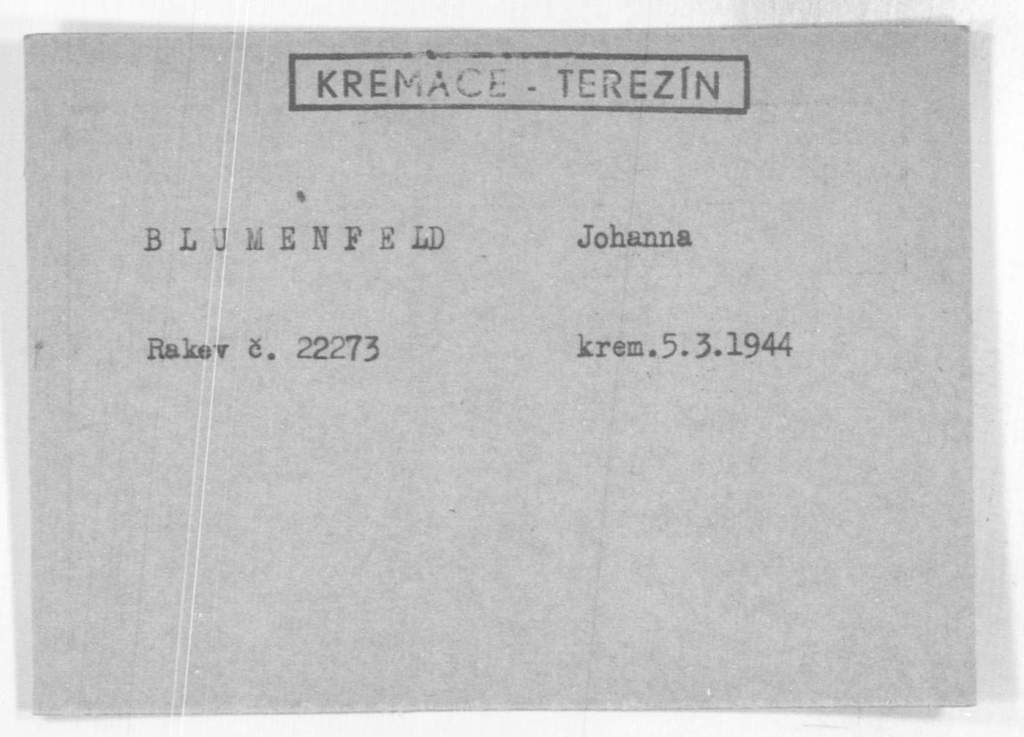
The Arolsen Archives contain the file card below for Johanna’s cremation in Theresienstadt on 5 March 1943.
- Hessisches Hauptstaatsarchiv; Wiesbaden, Deutschland; Personenstandsregister Sterberegister; Signatur: 608; Laufende Nummer: 926. ↩︎
- Johanna and Lina Blumenfeld, in: blankgenealogy.com; address books for Onsabrück 1935-36 and 1937-38. ↩︎
- Pressemitteilung 1 Juni 2010: Stolpersteine sollen in Wissmannstrasse an Opfer des Nationalsozialismus erinnern, spd-suedstadt-bult.de. ↩︎
- Lina Blumenfeld and Johanna Blumenfeld, blankgenealogy.com. ↩︎
- Gestapo plans from 10 July 1942 quoted in the description of the deportation from Bremen and Hanover to Theresienstadt on the website “Statistik des Holocaust”. ↩︎
- Hessisches Hauptstaatsarchiv; Wiesbaden, Deutschland; Personenstandsregister Sterberegister; Signatur: 608; Laufende Nummer: 926, in: Ancestry.com. ↩︎
 Blumenfeld Family Stories
Pingback: Sally Blumenfeld and Berta Freudenstein | Blumenfeld Family Stories